At-Home Microneedling and Derma Rollers: Where the Safe Limit Actually Is

Here is the short answer, and it has a hard edge. According to the FDA's guidance Regulatory Considerations for Microneedling Products, a needling product that penetrates beyond the stratum corneum, the dead outer sheet of your skin, is generally a regulated medical device rather than a cosmetic. Past that line you are performing a procedure, not a beauty step.
That is at-home microneedling safety in one sentence, and the agency draws the rest just as plainly. Its consumer update on microneedling devices states that "the FDA has not authorized any microneedling medical devices for over-the-counter sale." So what you can add to a cart is either a shallow cosmetic product that is not supposed to break living skin, or a device sold outside the category the agency built for needling.
I'm Kelly Hyde, a certified skincare specialist, and this is the one article in my roundup of at-home skin tech where I will not hand you a protocol. I own a roller. I have also read the case reports, and one cost a woman eighteen months of injections and a scar excision after she bought her device online. Everything past the shallow cosmetic range belongs to a board-certified dermatologist. I will say that more than once.
What needle depth actually determines
Depth decides which layer you are in, and that decides whether you are exfoliating or wounding. The FDA's microneedling devices page, updated October 15, 2025, puts the boundary in anatomical terms: "generally, microneedling products that do not penetrate into the living skin layers (epidermis and dermis)" and that claim only to exfoliate "would not be devices." Above that line you abrade dead cells. Below it you make holes in living tissue.
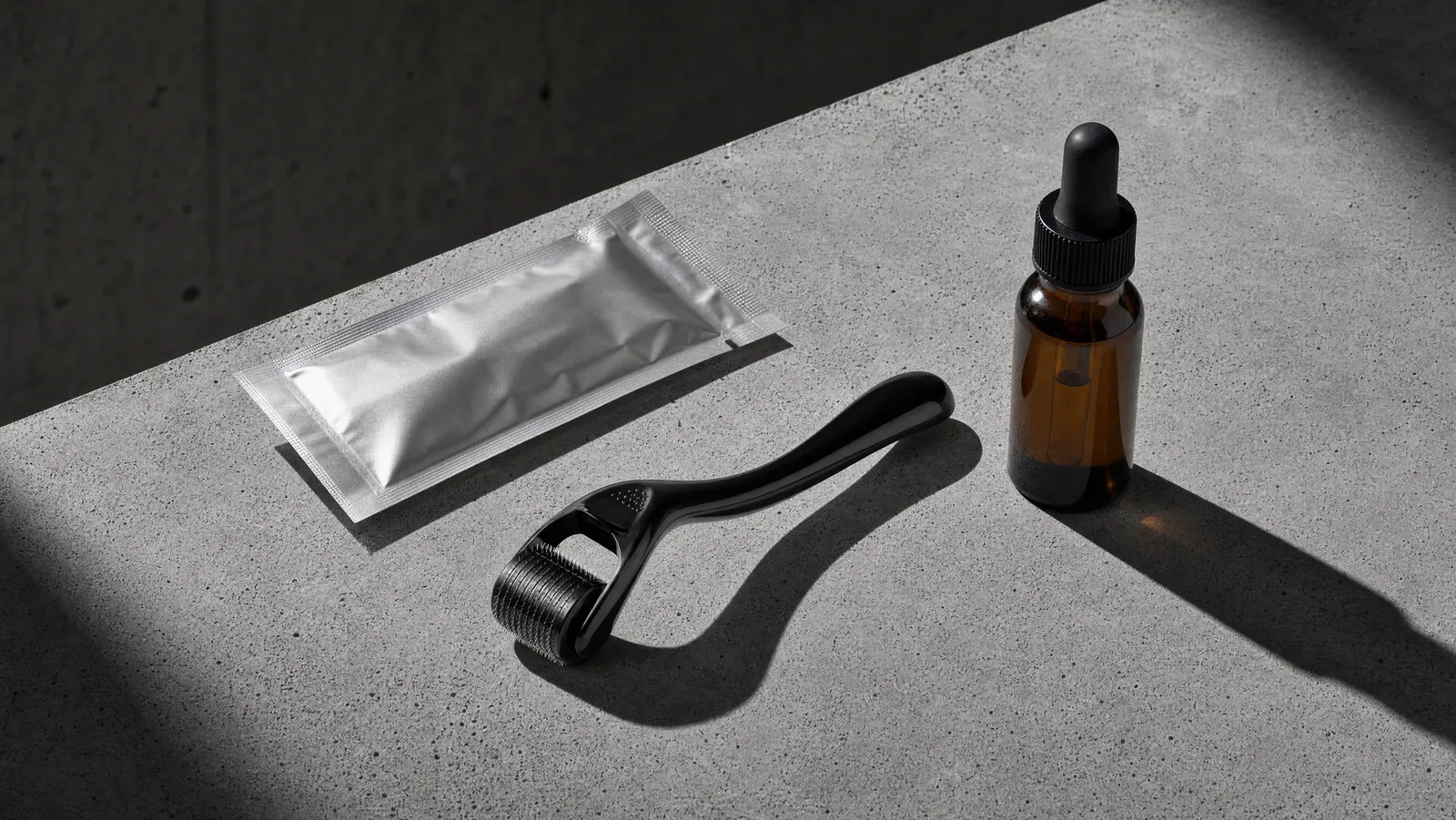
The numbers people quote come from the clinical literature, and that literature describes clinics. In their review "Microneedling: Advances and widening horizons" in the Indian Dermatology Online Journal, 2016, Singh and Yadav describe a standard dermaroller as carrying "192 fine microneedles, usually 0.5-3 mm in length and 0.1-0.25 mm in diameter," presterilized by gamma irradiation. For acne and other scars, they report, "a needle length of 1.5-2 mm is usually used," while for wrinkles "the needle length of 0.5 mm or 1.0 mm is usually recommended." The consumer category sits somewhere else entirely: "Home-care dermarollers (C-8) are used by patients themselves as they are of needle length less than 0.15 mm."
Read the right-hand column first. It tells you whose hands each row belongs in.
| Needle length | What the cited source says about it | Source and setting | |---|---|---| | Under 0.15 mm | "Home-care dermarollers (C-8)... used by patients themselves" | 2016 review, home category | | 0.5 or 1.0 mm | "Usually recommended" for wrinkles | 2016 review, clinician | | 1.5 to 2 mm | "Usually used" for acne and other scars | 2016 review, clinician | | Up to 2.5 mm | The depth automated pens reach | Cureus 2024 review, clinician |
None of those rows is a recommendation from me. Most of that map is drawn around a trained operator.
Two details there outrank any number on a box. The first is pressure: in that review, a 192-needle 2 mm roller passed over an area of skin 15 times "results in approximately 250 holes per square cm upto the papillary dermis depending on the pressure applied." The length is fixed; the depth achieved is a variable you set with your wrist. The second is the endpoint the review names, "uniform pin-point bleeding which is easily controllable," a sentence about a clinic and the clearest signal you have left cosmetics behind.
Jaiswal and Jawade's 2024 review "Microneedling in Dermatology: A Comprehensive Review of Applications, Techniques, and Outcomes" in Cureus says microneedling "primarily targets the dermis," describes pens "reaching depths up to 2.5 mm," and notes that rollers' "limited needle depth often makes them less effective than professional devices." That is the honest trade: what you can legally buy is shallow on purpose.
Where the home line sits, and who draws it
The FDA draws it at the stratum corneum, by claim and by design. Its 2020 guidance covers products with "an array of needles, 'micro-protrusion' tips, or pins," under the names "microneedling or needling instruments, needlers, dermal rollers, microneedle rollers, microneedle stamps, dermal stamps." It treats "claims or statements that indicate penetration or some effect beyond the stratum corneum" as evidence a product is meant to affect the structure of the body, and separately weighs penetration "as a result of the design or technology," considering needle length, sharpness and user control over depth. It classifies "microneedling devices for aesthetic use... as class II devices under 21 CFR 878.4430."
That status is a clearance, not an approval. The FDA's 510(k) program training transcript states that "a 510(k) is not a premarket approval" and that "only products or devices approved through the premarket approval process are considered FDA approved." Clearance means substantial equivalence to a predicate device, not a finding that a device works as advertised. The authorized uses are narrow too: cleared devices are indicated "to improve the appearance of facial acne scars, facial wrinkles, and abdominal scars" "in patients aged 22 years or older," and the risks of off-label uses "are not known."
Dermatology draws it at the operator. At the American Academy of Dermatology's 2018 Annual Meeting, board-certified dermatologist Tina Alster of Georgetown University Medical Center was quoted in an AAD meeting release saying home and nonmedical-spa rollers "have shorter, duller needles" and that "these devices are not meant to penetrate the skin." If they do, she warned, they "could do so in a way that leads to injury or infection, rather than rejuvenation." The procedure "should be performed by a trained, experienced physician, like a board-certified dermatologist."
One adjacent category has a harder boundary still. In a safety communication issued October 15, 2025, the FDA said it is aware of reports of "burns, scarring, fat loss, disfigurement, and nerve damage" from certain uses of radiofrequency microneedling, and wrote: "RF microneedling is a medical procedure, not a cosmetic treatment, and these devices should not be used at home." If you are shopping a needle-plus-energy handset, that is the review.
Derma roller vs microneedling pen
This question gets answered with more confidence than the research supports, so let me separate the sourced from the folklore.
Sourced: depth control. A roller is a barrel of fixed-length needles you drive by hand, and that "depending on the pressure applied" clause means depth varies between thin skin over your cheekbone and thicker skin on your chin. A motorized pen moves needles vertically, and Singh and Yadav describe that format as using "disposable needles and guides to adjust needle length." A guide is a mechanical stop. Your wrist is not.
Sourced: cleaning. Per the AAD release, home devices "are difficult to clean and maintain, with needles that dull quickly." The standard roller Singh and Yadav describe has 192 needles on a barrel you cannot swap for a sterile one. A pen takes a cartridge, which the FDA says must never be reused.
Folklore: the wound-shape argument. You will read everywhere that a rolling barrel enters and exits at an angle, tearing a V-shaped channel, while a pen punches a clean vertical hole, and that the tearing is what scars. I went looking for the histology and could not find it. The claim traces to vendor pages and forums, not a published comparison I can cite, and I found no head-to-head trial of a roller against a pen on the same faces. Nobody has studied this properly.
So: a pen's depth is set by a guide and a roller's by your hand, and the deeper either goes the more it is a procedure someone trained should run. If you want a device that never breaches the barrier, I have the energy-based modalities compared, and none involves a needle.
The five ways a home session goes wrong
1. Sanitation and reuse. The FDA states that "re-use of the needle cartridge is unsafe and is not consistent with the FDA's review and authorization," and that "re-using cartridges can cause or spread infection." Compare home practice: the clinic instrument in Singh and Yadav's review is "presterilized by gamma irradiation," while the home-care roller in the same review is cleaned "in hot tap water and shaken dry" and reused "twice or thrice a week for up to 100 times." Hot tap water is not sterilization, and the Cureus review is blunt that "proper sterilization is essential for those using at-home derma rollers to prevent infection and ensure safety."
What is at stake when infection control fails is documented. In an investigation published April 25, 2024 in CDC's Morbidity and Mortality Weekly Report, investigators examined HIV infections among former clients of an unlicensed New Mexico spa offering platelet-rich plasma microneedling facials, a facility that "did not follow recommended infection control procedures or maintain client records." The report describes presumptive transmission rather than proof, in a spa handling blood products rather than a home bathroom, and it remains the clearest published demonstration that needles plus poor infection control is a bloodborne-pathogen problem.
2. Needle dulling and bending. A dull needle does not stop working, it works worse, dragging instead of piercing, which is the failure mode the AAD release names in saying home devices have "needles that dull quickly." Needles that fine are hard to inspect for a bend by eye, and home rollers generally offer no way to tell when they have dulled.
3. Rolling over active acne or infection. Singh and Yadav list "active acne" and "herpes labialis or any other local infection such as warts" among contraindications, and report "aggravation of acne and reactivation of herpes, systemic hypersensitivity, allergic granulomatous reactions and local infections following the use of a nonsterile instrument" among adverse effects. The FDA's device page lists herpes reactivation, infection and pigmentation changes among less common risks, and warns that "some side effects may be permanent." Dragging a needle across a pustule is a mechanism for moving its contents elsewhere.
4. Applying actives to freshly needled skin. The FDA's device page states that microneedling devices "are not approved for delivery of cosmetics, topical medications" or similar substances. Then read the literature. In "Facial allergic granulomatous reaction and systemic hypersensitivity associated with microneedle therapy for skin rejuvenation", published in JAMA Dermatology in January 2014, Soltani-Arabshahi and colleagues reported three women who developed facial granulomas after microneedle treatment. Biopsies showed foreign-body-type granulomas, tissue cultures were negative, two had a branded vitamin C serum microinjected during the procedure and patch-tested positive to it, and one developed systemic hypersensitivity. Their conclusion is the sentence to tape to your mirror: "Application of topical products prior to microneedling can introduce immunogenic particles into the dermis and potentiate local or systemic hypersensitivity reactions."
The at-home version was published last October. In Cutis, 2025, Huang and colleagues described a destructive facial granuloma following self-treatment with vitamin E oil and an at-home microneedling device. A 44-year-old woman bought the oil and the device online and used the oil before, during and after passes with a device that "contained 0.25-mm titanium needles." She presented with ulcerated nodules on her chin grown over four months, and biopsies showed granulomas containing nonpolarizable foreign material. Intralesional triamcinolone over eighteen months produced "progressive and drastic improvement," followed by a scar excision. Note the needle length: 0.25 mm, the shallow end of what is sold for home use.
So do not stack actives onto a needling session. The retinoid in my guide to the best retinol serums and the ascorbic acid in my best vitamin C serums roundup are formulated for an intact barrier. A barrier with holes in it is a different organ.
5. Treating a condition the device was never authorized for. The cleared indications are acne scars, facial wrinkles and abdominal scars in people 22 and older, and the FDA says the risks of other uses "are not known." It has also not cleared any microneedling device for hair loss, which matters given how many scalp rollers are sold on that promise. If what bothers you is melasma, rosacea, cystic acne or thinning hair, a dermatologist can tell you in one appointment what you are actually treating.
Who should not do this at all
I am not writing a medical screening list in my own voice, because deciding whether you are a candidate for a skin-breaching procedure is a clinician's job. What I can do is report who the cited sources exclude.
The FDA's consumer update says "microneedling is not suitable for everyone," that "it may not be suitable for people with clotting or bleeding disorders," and that "you may want to avoid microneedling if you have conditions that affect your skin," naming eczema, diabetes and a weakened immune system. Singh and Yadav add active acne, local infections such as herpes labialis or warts, "moderate to severe chronic skin disease such as eczema and psoriasis," "blood dyscrasias, patients on anticoagulant therapy," "extreme keloidal tendency," and patients on chemotherapy or radiotherapy. The Cureus review adds that "the safety of the procedure during pregnancy has not been established." If you are pregnant or nursing, that sentence is the whole answer, and the rest of what I would use is in my guide to pregnancy-safe anti-aging skincare.
Two more risks. The Cureus review reports "transient hyperpigmentation, particularly in individuals with darker skin types," and says that while "persistent scarring, though uncommon, can occur," it is likelier "if the procedure is performed incorrectly," and technique is what a home user has least training in. Per the Cutis authors, "most MN devices are made of nickel and various other metals," linked to contact dermatitis and delayed-type hypersensitivity, so the device is an allergen exposure too.
The FDA recommends seeing "a health care provider who is specially trained in microneedling." Take that at face value. Anything past the shallow, non-penetrating cosmetic range is a procedure for a board-certified dermatologist or another licensed professional, and the price difference buys sterile single-use needles, a controlled depth, and someone who can recognize a granuloma at four weeks rather than four months.
The aftercare window
Reported as the sources' guidance, not as my protocol, because I am not writing one.
The clearest window I found is the Cutis case report's, and it exists because its authors had just finished treating the consequence of ignoring it: "topical products to avoid before, during, and 48 hours after undergoing MN include retinoids, vitamin C, vitamin E," continuing with exfoliants, acid-containing serums, fragrance-containing serums and oil-based serums. Read that against your shelf. For a lot of people, it is the shelf.
The Cureus review's post-procedure guidance is to "avoid harsh products or sun exposure for a few days following treatment" and use a gentle moisturizer, and on pigment it says "proper sun protection is crucial to prevent exacerbation." Singh and Yadav describe the course after a clinical session as "slight erythema and edema lasting for 2-3 days," advise regular sunscreen afterward, and report that clinical "treatments are performed at 3-8 week intervals."
Practically, the routine you are proudest of is the routine to pause. My anti-aging skincare routine goes on hold at both ends of a session, and the bland fallback looks like the gentle approach in Korean double cleansing minus any physical scrub. If you would rather build results without breaching anything, that is the right conclusion, and the routine I recommend in your 30s gets there on topicals. So does light: how red light dosing works is a question of joules and nanometers rather than millimeters of steel.
Frequently asked questions
Is at-home microneedling safe? It depends entirely on whether the device penetrates living skin. Per the FDA, a product that does not penetrate the epidermis and dermis, and claims only to exfoliate or smooth the look of skin, generally is not regulated as a device at all, while anything penetrating beyond the stratum corneum is. No microneedling medical device has been authorized for over-the-counter sale, and the AAD release quotes a board-certified dermatologist saying home rollers "are not meant to penetrate the skin" and can cause injury or infection if they do.
What derma roller needle depth is sold for home use? Singh and Yadav describe the home-care category as needles "less than 0.15 mm," and the at-home device in the 2025 Cutis case report carried 0.25 mm titanium needles. Published clinical depths run far longer: 0.5 or 1.0 mm for wrinkles and 1.5 to 2 mm for scars in that review, with pens reaching up to 2.5 mm per the 2024 Cureus review. Those are figures for clinician-performed work, not an endorsement of a number for your bathroom, and that review's "depending on the pressure applied" caveat means a hand-driven roller's printed length is not the depth it achieves.
Can I use vitamin C, retinol or facial oils with microneedling? Every source I read says no. The FDA states microneedling devices "are not approved for delivery of cosmetics, topical medications" or similar substances, and the 2014 JAMA Dermatology report concluded that applying topicals beforehand "can introduce immunogenic particles into the dermis and potentiate local or systemic hypersensitivity reactions." The 2025 Cutis authors list retinoids, vitamin C, vitamin E, exfoliants, acids, fragranced serums and oil-based serums among products to avoid before, during and for 48 hours after.
Are at-home microneedling devices FDA approved? No, and the wording matters. Cleared microneedling devices for aesthetic use are class II devices under 21 CFR 878.4430, authorized through the 510(k) pathway, and the FDA's own transcript says "a 510(k) is not a premarket approval." Clearance means substantial equivalence to a predicate device, not a finding that something works, and no microneedling medical device has been authorized for over-the-counter sale at all. A listing that says FDA approved is telling you something about the seller.
The actual takeaway
The reader I wrote this for has a 1.5 mm roller in a cart. Put it down. The sourced record points one way: the range sold for home use is shallow on purpose, the depths the research is excited about belong to a clinician with sterile single-use needles, and the gap between them is where the case reports live.
For the concerns that sent you looking at needles, topicals have better evidence and a far better risk profile, and the devices that never breach your barrier are the ones I recommend. Those live in the Next Gen Beauty at-home device guide. If your concern is a scar, melasma or anything a roller promises to fix, book the appointment instead. A board-certified dermatologist is the cheaper purchase in the end.
About the Author
Kelly Hyde
Kelly Hyde is a certified skincare specialist and beauty trend forecaster, and the founder of Next Gen Beauty Reviews. She spends her time testing the latest K-beauty launches, at-home beauty devices, and skincare tools so you do not have to, and only recommends products she would put in her own routine.