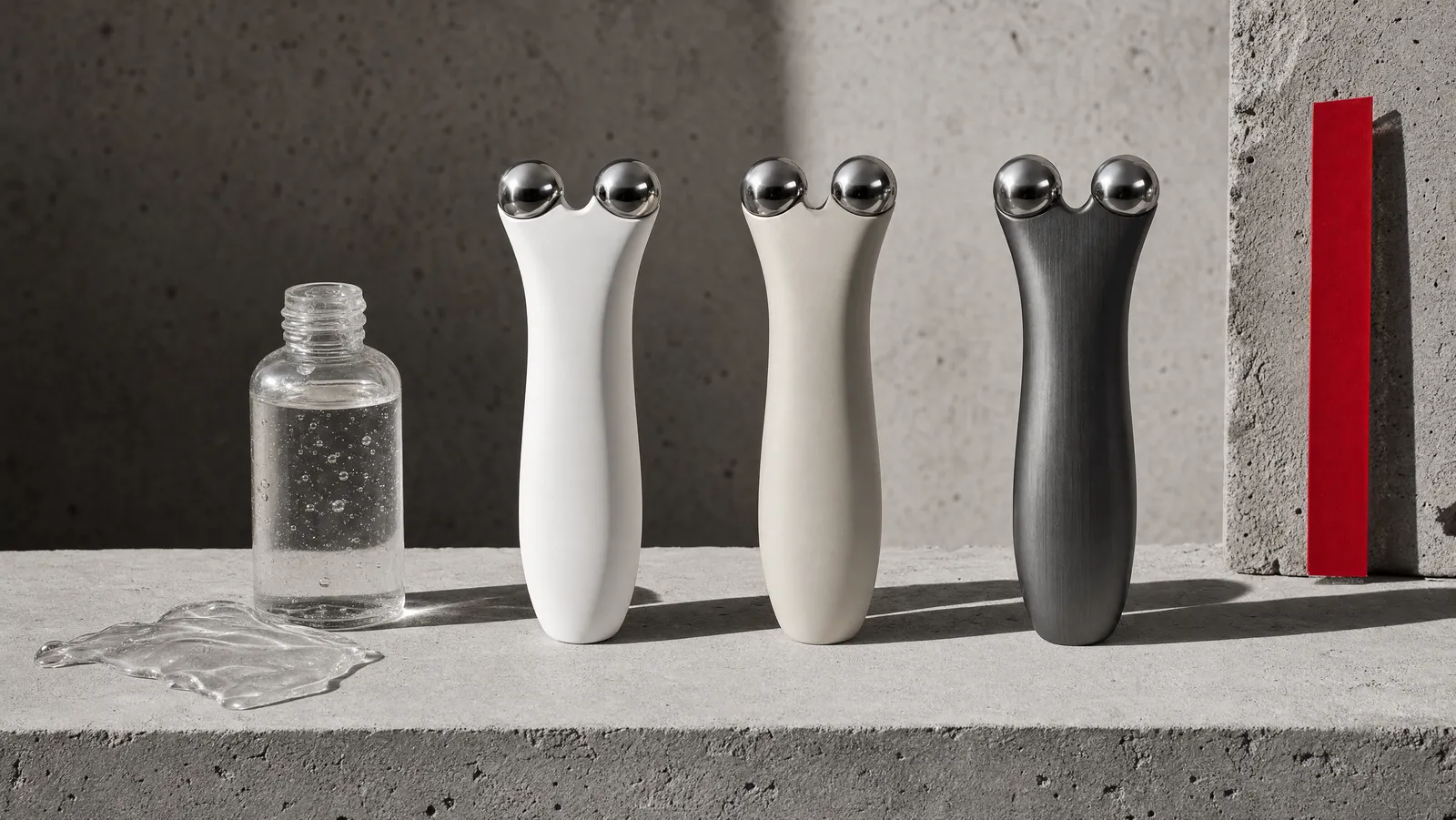
Microcurrent vs Radiofrequency vs Ultrasound: Which Modality for Which Concern

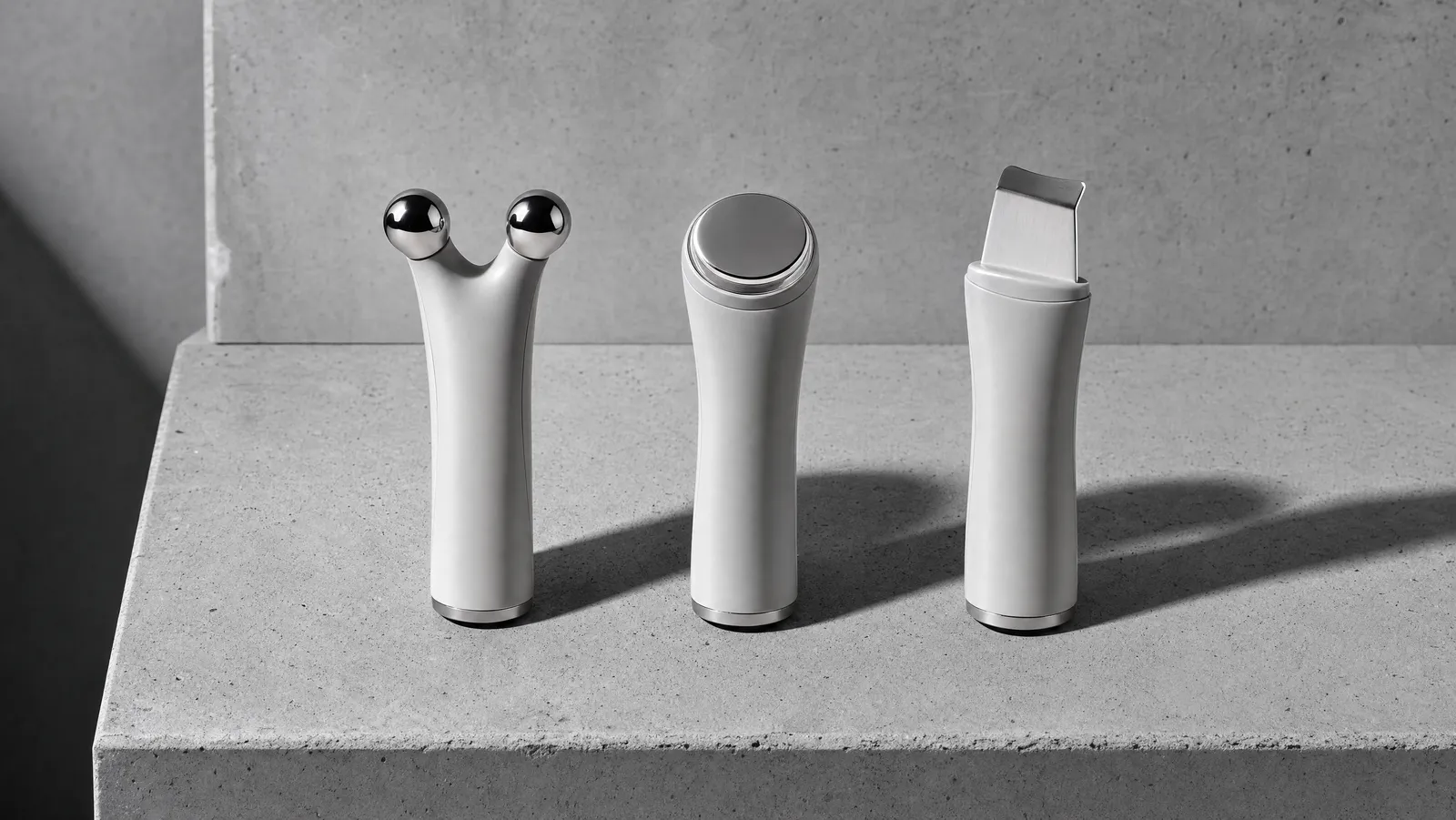
Softening along the jaw and a slacker contour: microcurrent, which works on muscle. Crepey texture and lost firmness in the skin itself: radiofrequency, which heats the dermis. Serums that seem to sit on top of your face: a low-frequency ultrasonic device, on a mechanism studied for drug delivery rather than for faces. A visible lift at depth: none of the three, and nothing you can buy for home use.
I am Kelly Hyde, a certified skincare specialist, and microcurrent vs radiofrequency is the hardware question that reaches my inbox more than any other, usually with ultrasound thrown in as a tiebreaker. The three are sold with nearly interchangeable copy, which is a marketing decision rather than a physical one. Current moves muscle. Radio waves make heat. Ultrasound is a pressure wave, and that one word covers two interventions that are not remotely the same. Hardware picks by category live in my guide to the best at-home beauty devices. This is the step before that, where you work out which physics you are shopping for.
The three modalities, in one table
Read the last column first. It is the one that saves money.
| Modality | Tissue it targets | What it plausibly helps | A protocol someone has published | What it will not do | |---|---|---|---|---| | Microcurrent (sub-sensory) | Facial muscle, plus skin at the surface | Same-day contour, cumulative muscle thickness | NuFACE publishes 5 minutes a day, 5 days a week for 60 days | Change pigment, pores or redness | | Neuromuscular stimulation | Facial muscle, strongly enough to contract it | Measurable muscle thickness over 12 weeks | 20 minutes a day, 5 days a week in the trial everyone cites | Reduce wrinkle depth, which that trial never measured | | Radiofrequency (home, bipolar or multipolar) | Dermis, by resistive heating | Wrinkle grade, dermal thickness, firmness | The Newa trial ran 3 sessions weekly for 4 weeks, then 2 weekly for 8 | Reach what a monopolar clinic device reaches | | Low-frequency ultrasonic (home) | Stratum corneum, by cavitation | Getting a topical past the surface | No consensus human protocol has been published | Lift tissue, or focus energy at a set depth | | Microfocused ultrasound (clinic) | Discrete points at 1.5 to 4.5 mm | Lifting lax brow, submental and neck tissue | Operator-delivered passes under ultrasound imaging | Exist in any form you can run on yourself |
That fourth column is phrased carefully. These categories have no standard dose, only protocols that individual manufacturers and trials happened to choose, and the gap between them is often the whole result.
Microcurrent: stimulating muscle
Two metal probes, conductive gel, and a current low enough that most people feel nothing beyond a faint metallic taste near the jaw. The pitch is resistance training for your face, and the argument is never about physics. It is about dose.
One definitional split matters before you shop: true microcurrent is sub-sensory, while neuromuscular electrical stimulation uses enough current to produce a contraction you can see. Several studies quoted in microcurrent marketing tested that second thing.
For scale on dose, NuFACE's microcurrent explainer page recommends five minutes a day, five days a week for the first 60 days, and footnotes its own cellular claims as "Based on third-party clinical studies of microcurrent technology, not specific to NUFACE devices." That is the most honest line on any brand page I read for this article.
The trial the industry leans on is Kavanagh and colleagues' "Use of a neuromuscular electrical stimulation device for facial muscle toning: a randomized, controlled trial" in the Journal of Cosmetic Dermatology, 2012. According to the abstract, 108 healthy women with a mean age of 43.7 used a facial NMES device 20 minutes a day, five days a week for 12 weeks, and assessor-blinded ultrasound found zygomatic major muscle thickness rose 18.6 percent against baseline in the device group but not in the non-intervention control group. Note what the blinded instrument measured: muscle thickness. Not wrinkle depth, not elasticity, not dermal thickness.
Regulators are cool on the wider category. The FDA's consumer page on electronic muscle stimulators says such a device "may be able to temporarily strengthen, tone or firm a muscle," states the agency "is not aware of scientific information to support many of the promotional claims" made for these products, and warns that without diet and exercise they will not, on available data, "create a major change in your appearance." It covers body and abdominal stimulators rather than facial wands, so read it as the agency's posture on the mechanism.
Home-use evidence is thinner still. In their 2024 review "Development of Home Beauty Devices for Facial Rejuvenation" in Clinical, Cosmetic and Investigational Dermatology, Bu and colleagues assembled 18 clinical studies of home devices, and their tables include exactly one microcurrent study, which is that same Kavanagh trial, listed as a randomized controlled trial of the Slendertone Face device reporting improved radiance, skin tone and wrinkles over 12 weeks against a control. One trial, counted twice by the industry.
So the ceiling is clear. A thicker cheek muscle is not more collagen, and nothing in the muscle literature speaks to pigment, pore size or redness. I take the evidence apart study by study in does microcurrent actually work, and the hardware sits in the best microcurrent devices. If what you like is the drainage effect rather than the electricity, the best gua sha tools do something comparable by hand.
Radiofrequency: heating the dermis
Radiofrequency ignores muscle. It makes heat inside tissue and lets the heat do the work.
The clearest account I found is Mohamed Lotfy Elsaie's review "Cutaneous Remodeling and Photorejuvenation Using Radiofrequency Devices" in the Indian Journal of Dermatology, 2009. According to that review, "radiofrequency current is formed when charged particles flow through a closed circuit," and "as the energy meets resistance in the tissue, heat is produced" under Ohm's law. When collagen fibers are heated, "some of the cross-links are broken, causing the triple helix structure to unwind." Immediate heating produces denaturation and fibril contraction, after which "an inflammatory wound healing response ensues with long-term neocollagenesis."
Two details there outrank any brand claim.
There is no single magic temperature. Elsaie attributes denaturation to "a combination of both the maximal temperature and the exposure time," not a threshold you cross. That is why I will not quote one temperature figure for home handsets as a class. Frequencies, power and cutoffs are per device, and a brand publishing none of them has told you something.
Electrode spacing is a depth spec you can see. In a bipolar configuration, the review says, "the depth of penetration is limited to approximately half the distance between the electrodes."
Home units also live inside a hard constraint. Bu and colleagues report they "often use bipolar or multipolar RF, eliminating the need for additional cooling," given the challenge of controlling the high energy of monopolar RF, and state the trade-off plainly: "multipolar RF may have a weaker therapeutic effect than monopolar RF due to its shallower energy penetration." That is the honest answer to whether your handset does what the clinic does.
For a device that publishes numbers, take the Newa. The PubMed-indexed home-use study of it describes a device that "emits 12 W of 1 MHz, RF energy through six electrodes arranged in a linear fashion," with three dermatologists scoring photographs on the Fitzpatrick Wrinkle and Elastosis Scale. The FDA's 510(k) record K130793, decided August 16, 2013, calls it "a prescription home use device intended for non-invasive treatment of mild to moderate facial wrinkles and rhytides." A later trial enrolled 47 subjects treating three times weekly for four weeks then twice weekly for eight more, and concluded it worked for self-administered rejuvenation, with an EndyMed-affiliated author on the paper.
Keep the scale in view. Of Bu's 18 studies, nine were radiofrequency, only five were randomized controlled trials, the longest follow-up was 12 weeks, and the authors flag small samples and non-randomized controls. On safety they report that "apart from transient redness and swelling, no other adverse reactions were observed," while citing a recall of an early Stop Eye radiofrequency device for a "potential risk of high temperatures in the device probe leading to low-temperature burns." Heat is the active ingredient, so heat is the failure mode, and that is the lens I apply when sorting the at-home RF handsets I recommend.
Ultrasound: two very different things
This is where the category misleads people, and it is not subtle.
In a clinic, ultrasound means focused energy at a measured depth. In their 2016 pilot study of microfocused ultrasound with visualization, published in the Journal of Clinical and Aesthetic Dermatology, Werschler and Werschler describe transducers "emitting focused ultrasound at frequencies of 4.0, 7.0, and 10.0MHz at focal depths of 1.5, 3.0, and 4.5mm, respectively," with roughly 95 percent of delivered energy becoming heat at the focal point and briefly raising local temperature "to ~65°C." Each transducer "can also provide tissue imaging to a depth of 8mm." The FDA's 510(k) record for the Ulthera System, decided December 11, 2013, lists indications to "lift the eyebrow" and "lift lax submental (beneath the chin) and neck tissue," and says the imaging exists to "confirm appropriate depth of treatment such as to avoid bone."
Sit with that last phrase. An operator watches where the energy lands so it does not land on bone. That is the intervention invoked every time a listing says HIFU. Its evidence is not overwhelming either: that pilot was open-label with no control group, 20 of 21 enrolled subjects treated, and blinded assessment rated 6 of 14 evaluable subjects as improved at one year.
At home, ultrasound means at least three unrelated things.
The first is sonophoresis, which moves topicals through the stratum corneum rather than lifting anything. According to a 2024 review of ultrasound-mediated transdermal drug delivery in Advances in Pharmacological and Pharmaceutical Sciences, low-frequency sonophoresis sits roughly in the 20 to 200 kHz band and penetrates deeper than higher frequencies, cavitation is the mechanism most often named, and the exact mechanism remains unclear. Note the field: drug delivery, not facial contour.
The second is the ultrasonic spatula. Listings quote figures like 24,000 Hz, 28,000 vibrations per second and "over 30,000 Hz," which are product specifications rather than measured outputs, and I could find no peer-reviewed evidence for the exfoliation or absorption claims attached to them. No one appears to have studied them properly. That is the honest answer.
The third is the growing shelf of devices marketed as home HIFU. The one published wrinkle study I could find, "Efficacy of a home-used high-intensity focused ultrasound device on wrinkle reduction" in Skin Research and Technology, 2023, tested a 4 MHz device with a 1.5 mm focal depth on the back skin of 30 nude mice, 30 or 60 seconds a day for one or two weeks. Collagen types I and III and elastin rose, MMP-1 and TIMP-1 fell, with no significant difference between the 30 and 60 second groups. The authors call the results preliminary and state that human effectiveness still needs to be evaluated.
One absence is equally telling. Bu's review built an efficacy evaluation system for home beauty devices across radiofrequency, LED, microcurrent and combined-technology studies. Home ultrasound does not appear in it at all.
So, plainly: a home unit with a nominal 1.5 mm focal depth is not the system firing 4.0, 7.0 and 10.0 MHz transducers to 4.5 mm while an operator watches tissue 8 mm down. Both get called ultrasound. Only one of them is cleared to lift anything.
Which facial device modality for which concern
Laxity and contour. Microcurrent for the same-day change brands promise, which you would then maintain forever, radiofrequency for the slow dermal route with better home evidence. Wrong tool: any ultrasonic device that does not publish a focal depth, since no human home-ultrasound lifting protocol exists. The dramatic lift in the photos you are judging your jaw against was usually a clinic procedure.
Fine lines and texture. Radiofrequency, by a distance, because that is where nine of Bu's 18 studies sit and where wrinkle grade and dermal thickness were measured. Wrong tool: microcurrent, whose one blinded measurement was muscle thickness. No handset here has the evidence base of a topical retinoid, so get the best retinol serums and an anti-aging skincare routine running first; the routine I build at 40-plus treats a device as the last thing you add.
Tone, redness and pigment. None of the three. This is light's job, the fourth modality people fold into this comparison by mistake. Bu's review includes four LED studies and notes a few participants had transient erythema after initial use. I compare published output figures in the best LED face masks, and for the dose arithmetic rather than the shopping, read what the LED wavelengths actually do first.
Congestion and oil. None of the three. No home microcurrent or radiofrequency handset has published sebum data, the radiofrequency research that does report lower sebum ran on clinic fractional microneedling systems rather than smooth-tipped wands, and the ultrasonic spatula claims have no peer-reviewed support I can find. This concern is answered by what you put on your skin.
Stacking modalities, and when not to
Combination devices are now the default at the premium end, and they create an attribution problem. Choi and colleagues ran a randomized split-face trial of a home-use handheld multi-energy device in 36 healthy Korean women over eight weeks, published in Lasers in Medical Science in 2024. The abstract reports improvements against both baseline and the untreated side in hydration, elasticity, roughness, pore size and eye wrinkle volume, with increased type 1 collagen and no adverse effects. But the device combined low-level light, low-dose radiofrequency, low-energy microcurrent and low-intensity ultrasound, so no single energy earned the credit, and a four-in-one result cannot justify buying any one modality.
On session order and cumulative heat I will not invent a protocol, because none has been tested. Every home trial above ran one device on one schedule, so two heat-based sessions in one evening sits outside the evidence entirely. Follow the instructions in your own box, and treat that Stop Eye probe-temperature recall as the reminder that heat is what goes wrong.
Radiofrequency plus needles deserves its own warning. In a safety communication issued October 15, 2025 on potential risks with certain uses of radiofrequency microneedling, the FDA says it is aware of reports of "burns, scarring, fat loss, disfigurement, and nerve damage," plus "the need for surgical repair or medical intervention to treat injuries," states the procedure "is a medical procedure, not a cosmetic treatment," and says plainly that "these devices should not be used at home." That notice concerns RF microneedling systems rather than the smooth-tipped handsets here, and it is the right context for where at-home microneedling fits beside the rest of this hardware.
Frequently asked questions
Microcurrent vs RF: which should I buy first? Pick by concern, not price. If contour bothers you and you will commit to near-daily sessions, microcurrent is the category with a blinded muscle-thickness result behind it. If the quality of the skin itself bothers you, radiofrequency is where home trials measured wrinkle grade and dermal thickness. Buying the wrong one of those two is the expensive mistake here.
RF vs ultrasound for skin at home: which has better evidence? Radiofrequency, and it is not close. Nine of the 18 clinical studies in Bu's 2024 review were radiofrequency. Home ultrasound is absent from that review entirely, and the one home HIFU wrinkle study I found ran in mice, with its own authors saying human effectiveness still needs to be evaluated.
Is an at-home ultrasound device the same as Ultherapy? No. The Ulthera System's FDA record covers transducers that focus energy at set depths, with imaging to 8 mm so the operator can confirm depth and avoid bone, and it is cleared to lift the eyebrow and lax submental and neck tissue. No home ultrasonic device I have seen publishes that combination of focal depth, energy and visualization, and none carries a lifting clearance.
Are these devices FDA approved? No, and the distinction is load-bearing. Consumer devices here are cleared through the 510(k) pathway, meaning substantially equivalent to something already on the market. The FDA's own 510(k) program training transcript states that "a 510(k) is not a premarket approval" and that "only products or devices approved through the premarket approval process are considered FDA approved." Cleared is a marketing permission, not a finding that a device works as advertised.
The honest triage
Muscle, heat, or pressure waves. That is the entire decision, and phrasing it that way stops the marketing working on you. Microcurrent has one blinded number and it is about muscle. Radiofrequency has the deepest home evidence base, and that is still nine studies inside an 18-study review, with 12-week follow-ups. Ultrasound at home is either a penetration aid or an unstudied promise borrowed from a clinic system that needs an operator and an image to stay safe.
Decide which tissue you are trying to change, then read the specs for that one category. When you are ready to compare hardware, the full at-home device lineup sorts it by modality, with the output figure to demand from each.
About the Author
Kelly Hyde
Kelly Hyde is a certified skincare specialist and beauty trend forecaster, and the founder of Next Gen Beauty Reviews. She spends her time testing the latest K-beauty launches, at-home beauty devices, and skincare tools so you do not have to, and only recommends products she would put in her own routine.