Red Light Wavelengths Explained: 630nm, 660nm, 850nm and the Dose That Matters

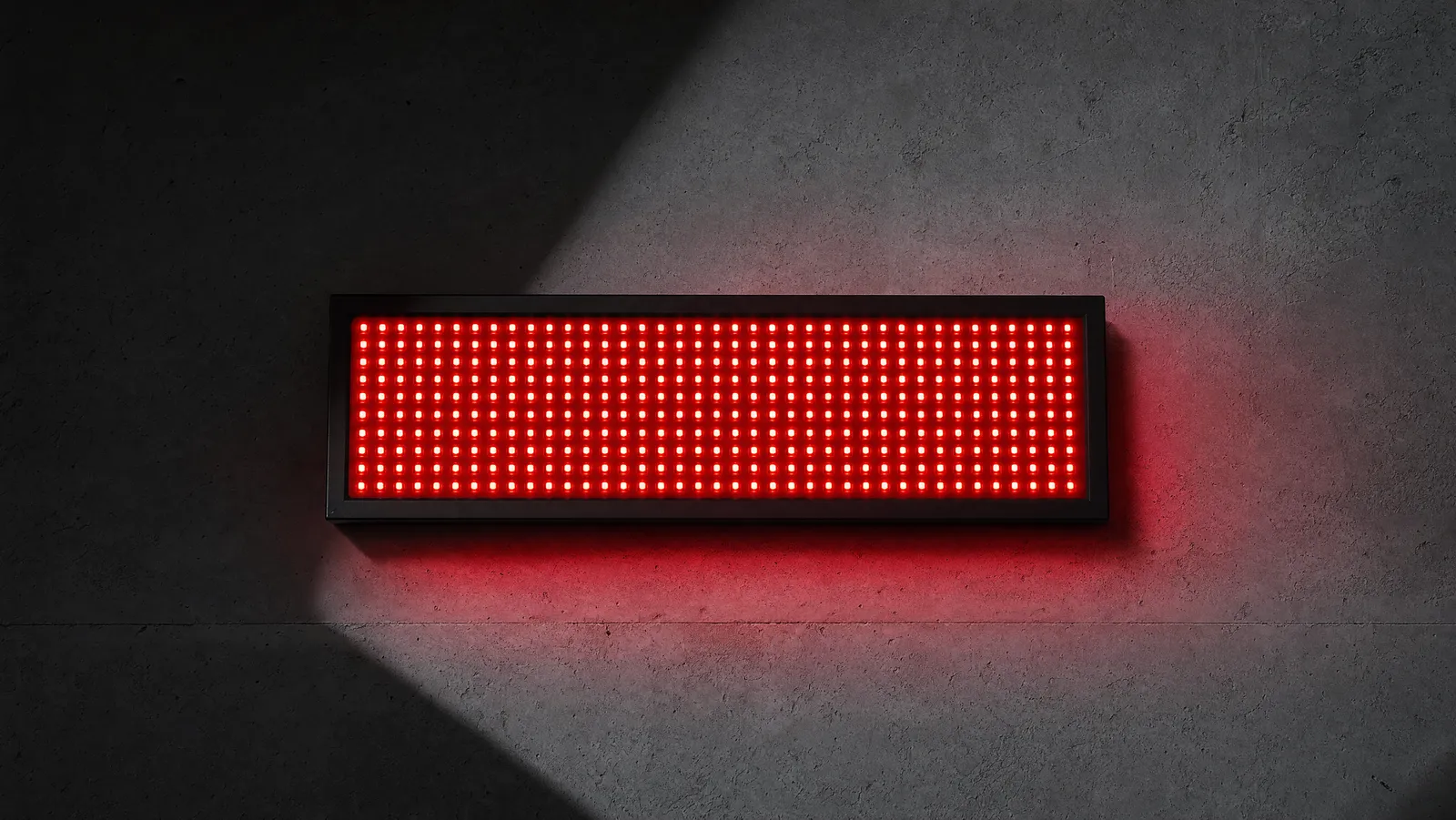
Red light around 630 to 660nm for fine lines, tone and surface texture. Near-infrared around 830 to 850nm when you want light reaching deeper tissue. Blue near 415nm only if your problem is acne. That is the entire wavelength answer, and it is the easy half. The number that actually decides your result is the one almost no box prints.
I am Kelly Hyde, a certified skincare specialist, and I have spent more time with LED spec sheets than anyone should. Here is the thing about red light therapy wavelengths for skin: the nanometers on the box tell you which tissue the light is aimed at, and nothing about whether enough of it arrives. Two masks can both say "630nm + 850nm" and deliver very different doses. LED is one of the modalities I break down in my guide to the best at-home beauty devices, and the only one where you can do the math yourself before spending a cent.
What a wavelength actually changes
Wavelength does two things. It decides what molecule absorbs the light, and how far the light gets.
The absorption part is the mechanism. According to the review by Avci and colleagues in Seminars in Cutaneous Medicine and Surgery, the photons "are absorbed by mitochondrial chromophores in skin cells," "in particular cytochrome c oxidase (CCO) which is contained in the respiratory chain located within the mitochondria," after which "mitochondrial respiration and adenosine triphosphate (ATP) production" rise. That is photobiomodulation in one line: light hits an enzyme in the mitochondria, cellular energy production shifts, signaling follows.
The depth part is why the band on the box matters. The same review says phototherapy "employs light with wavelengths between 390-1,100 nm," that "wavelengths in the range of 390 nm to 600 nm are used to treat superficial tissue," and that "longer wavelengths in the range of 600nm to 1,100nm, which penetrate further, are used to treat deeper-seated tissues."
That split is real. It is also where the marketing bends, because depth figures are almost always quoted without the thing that determines them: the cutoff you chose. In a computational study by Ash and colleagues in Lasers in Medical Science, a Monte Carlo simulation of layered skin found that "on increasing the wavelength of light used in skin therapy, there is a corresponding increase in the penetration depth." Their headline number was a maximum calculated depth of 5378 micrometers, about 5.4mm, at 750nm, measured at the contour where intensity has fallen to 1 percent. In the same discussion they report roughly 5mm at that 1 percent criterion against 0.37mm at a 13.5 percent criterion, for the same source and skin type.
Read that twice. The same beam is "5mm deep" or "0.4mm deep" depending on how little light you will call a dose, so any chart offering one tidy depth per wavelength is decoration.
One more finding earns its place: beam width matters. The authors saw "a noticeable increase in the penetration depth when the beam width is increased from 1 up to 5 mm," with a critical point near 10mm beyond which widening stops helping. That is the real argument for a full-face panel over a pen-sized wand. Their model also topped out at 750nm, so I will not quote a depth for 850nm from it.
630nm, 660nm and 850nm, side by side
| Band | What absorbs it | What the literature has actually tested | What it is not for | |---|---|---|---| | About 415nm (blue) | Porphyrins made by acne bacteria | Jean-Pierre and colleagues report porphyrins with "the most substantial absorption between 407 and 420 nm" and skin penetration of "approximately 0.3 mm" at 415 to 545nm | Wrinkles, firmness, anything dermal | | About 630nm (red) | Cytochrome c oxidase, minus scattering losses | Red at 600 to 650nm "allows for 1-2 mm deeper skin penetration" than blue, per the same review; this band carried the dose in the Wunsch trial below | Reaching muscle or fat | | About 660nm (deep red) | The same mitochondrial chromophore | Widely used in panels; I found no head-to-head trial against 630nm on facial skin at matched dose | Doing a different biological job than 630nm | | About 830 to 850nm (near-infrared) | The same chromophore, reached deeper in tissue | Lee and colleagues tested 830nm alone, 633nm alone and the two combined on facial wrinkles | Anything visible; the light itself is invisible |
The honest summary: the two red numbers are closer to each other than the marketing implies, and the red-versus-near-infrared split is the one that earns space on a box. On which is better, Avci and colleagues are blunt: "There is no agreement as yet on several important parameters particularly whether red, NIR, or a combination of both wavelengths is optimal for any particular application."
The best evidence for running both is older than most of the masks selling it. In a prospective, randomized, placebo-controlled, double-blinded split-face study in the Journal of Photochemistry and Photobiology B, Lee and colleagues treated 76 patients with facial wrinkles on the right half of the face only, randomized to 830nm alone, 633nm alone, the two combined, or sham light, twice a week for four weeks. The abstract reports objectively measured wrinkle reductions of up to 36 percent and elasticity increases of up to 19 percent against baseline on the treated side, with no adverse effects.
Sham-controlled, split-face, blinded, and eight sessions in total, which should tell you something about the "20 minutes every night forever" protocols.
Dose: the number almost nobody prints
Here is the arithmetic, and it is the most useful thing on this page. Irradiance is how hard the light hits you, in milliwatts per square centimeter. Dose, properly called fluence or radiant exposure, is irradiance multiplied by time, in joules per square centimeter:
Dose in J/cm2 = irradiance in mW/cm2 x time in seconds / 1000
The divide-by-1000 converts milliwatts to watts. Say a mask claims 35 mW/cm2 in its red band and recommends 10 minutes: that is 35 x 600 / 1000, or 21 J/cm2. Twenty minutes would be 42 J/cm2; five would be 10.5. You now know more about that mask than its product page tells you.
You do not have to take my word for the formula; run it against a published trial's own table. Wunsch and Matuschka, in Photomedicine and Laser Surgery, enrolled 136 volunteers, randomized 113 across four treatment groups, recruited 23 untreated controls separately rather than by randomization, and treated twice weekly for 30 sessions. Their Table 2 gives irradiance in the 611 to 650nm band, session length, and dose:
| Treatment unit | Irradiance, 611-650nm | Session | Reported dose, 611-650nm | |---|---|---|---| | ELT 2 | 7.1 mW/cm2 | 20 min | 8.5 J/cm2 | | ELT 30 | 10.4 mW/cm2 | 15 min | 9.4 J/cm2 | | C 46 sun | 5.9 mW/cm2 | 25 min | 8.9 J/cm2 | | CVT/RVT | 13.3 mW/cm2 | 12 min | 9.6 J/cm2 |
Check the last row: 13.3 x 720 / 1000 = 9.58, and they report 9.6. Every row reconciles. The formula is a definition, not a heuristic.
Now look at the size of those numbers: irradiances of 5.9 to 13.3 mW/cm2, and doses the authors describe as normalized to about 9 J/cm2 in the red band. The results were not nothing. In a blinded expert vote on wrinkles at 30 sessions, the red-light group was rated better in 69 percent of cases and worse in 17 percent, against 4 percent better and 74 percent worse in controls. Profilometric roughness fell by a mean of -1.79 against a rise of 0.95 in controls, and the ultrasound collagen intensity score rose by a mean of 5.75 against -0.26. Both changes inside the red-light group were significant at p below 0.001; measured against the controls, the collagen difference held at p below 0.001 and the roughness difference at p equals 0.003.
Two caveats. Those were polychromatic lamp units, not LED arrays, so the spectrum is broader than a mask's narrow bands. And 30 sessions at twice weekly is fifteen weeks; nobody here got a result in a fortnight.
Distance is the hidden variable in every irradiance claim. Light leaving an LED spreads, and the same power over more area is less irradiance. Cronshaw and colleagues, in a 2025 pilot study in Dentistry Journal, measured five randomly chosen hand-held home-use LED devices and quantified it: four of the five had a beam divergence angle of around 74 degrees, and "in near contact, a 3 cm diameter device has a surface area beam exposure of approximately 7 cm2," while "at a distance of 2 cm, the area of the beam is four times higher at 28 cm2," and at 7.5cm "the beam area is 154 cm2." Same diodes, twenty-two times the area. A spec sheet that omits the measurement distance has told you nothing. One quiet advantage of a mask: it sits on your face, so the geometry is fixed and close.
Why more is not better
This is the part most buyer's guides skip. The canonical reference is "Biphasic Dose Response in Low Level Light Therapy" by Huang, Chen, Carroll and Hamblin, published in Dose-Response in 2009. Its central observation is that "a biphasic dose response has been frequently observed where low levels of light have a much better effect on stimulating and repairing tissues than higher levels of light," a pattern usually drawn as the Arndt-Schulz curve. The plain version: "if insufficient energy is applied there will be no response," and "when too much energy is applied then the stimulation disappears and is replaced by bioinhibition instead."
The numbers are smaller than most people expect. The authors write that "fluences of red or NIR as low as 3 or 5 J/cm2 will be beneficial in vivo," and that "a large dose like 50 or 100 J/cm2 will lose the beneficial effect and may even become detrimental." Several of the cell-level peaks in the studies they collect land at 0.18, 0.3, 0.45 and 0.88 J/cm2 depending on cell type, with one human fibroblast experiment showing "a maximum increase of 30% after 0.88 J/cm2 and an actual reduction appearing at 9 J/cm2."
Be careful how far you carry that. Most of those figures come from cultured cells and animal wounds, not human facial skin under a mask, and a dose that over-saturates a fibroblast in a dish is not automatically a dose that harms your cheek. Avci and colleagues put the practical version conservatively: "it is important to consider that there is an optimal dose of light for any particular application."
A second twist partly breaks the formula I just taught you. Huang and colleagues note that joules alone is a weak description of a dose, because "energy has two components, power and time," and "it has been demonstrated that there is not necessarily reciprocity between them": "if the power doubled and the time is halved then the same energy is delivered but a different biological response" is often observed. So 21 J/cm2 at 35 mW/cm2 for ten minutes and the same 21 J/cm2 at 70 mW/cm2 for five may not be the same event in your skin.
The upshot: run the session the manufacturer validated, and if you want a faster result, improve your consistency rather than your dose. The same logic governs actives, which is why my anti-aging routine guide sequences device nights around a steady base, and my notes on retinol serums cover the active people over-apply for the same reason.
Reading a real spec sheet
What I look for, in order:
- Nanometers, not color names. "Red" covers everything from 620 to 700nm. A listing that will not name a number either does not know it or does not want you comparing.
- Irradiance with a stated distance. A bare "100 mW/cm2" is a marketing number; "100 mW/cm2 at the surface" is a spec. Per the Cronshaw beam-area findings, distance can move the real figure by more than an order of magnitude.
- Per-band irradiance, not a combined total. The most common trick. Cronshaw and colleagues measured one device at 127.5 mW/cm2 overall, splitting into 67 for red, 47.5 for near-infrared and 41 for blue. If a four-wavelength mask quotes one total, the band you care about is a fraction of it.
- Whether output holds for the session. In that study, two of five devices lost about 50 percent of their initial power by three minutes, while a third held steady to its limit. A dose computed from a fading device is fiction.
- A session time the maker will commit to. You need it for the arithmetic, and "10 to 30 minutes, as desired" hands you a dose range of three to one.
Now the uncomfortable part. Cronshaw and colleagues concluded that the manufacturers' own dosing advice was "inconsistent with an accurate dose delivery," that the "proposed dosimetry fails to consider the relevance of the beam divergence angle and optical attenuation," and that it is "premature to offer professional endorsement" of home-use LED devices, citing "the lack of specific supporting evidence to promote this type of device." Their sample was torch-style hand-held and intra-oral units, not facial masks, so it is not a verdict on masks. Read it for what it is: when somebody independently measured what these things emit, the labels did not survive contact.
So treat a missing irradiance figure as information. A brand listing LED count, color count and wavelengths but no irradiance and no distance has chosen not to publish a number it could have measured, and I price that accordingly. It is the filter I use on the LED masks I have tested and recommend.
What LED will not do
- It will not reach what it cannot reach. Blue light, at the "approximately 0.3 mm" the Jean-Pierre review gives it, is working very near the surface. No session length turns a surface wavelength into a deep one.
- It will not work on a schedule you choose. The two trials above ran eight sessions over four weeks and 30 over fifteen. Neither reported a two-week result.
- It will not deliver the same dose to every skin tone. Epidermal melanin absorbs visible light before it reaches the dermis, which is why the Ash model is built around a melanin-rich epidermal layer and why Avci and colleagues list "failure to account for skin pigmentation" among the possible reasons phototherapy studies come back negative. More pigment means a different delivered dose at the same setting, and I found no trial data quantifying that adjustment for home masks. As far as I can tell, nobody has studied that properly.
- It is not FDA approved, and the distinction is not pedantry. FDA's own 510(k) program transcript states that "a 510(k) is not a premarket approval" and that "only products or devices approved through the premarket approval process are considered FDA approved." FDA's premarket notification page adds that a 510(k) "requires demonstration of substantial equivalence to another legally U.S. marketed device," and that the order "clears the device for commercial distribution." Cleared means close enough to something already sold, not a finding that the wavelengths on your box do what the box says.
- Protect your eyes, and do not assume the bundled goggles count. Cronshaw and colleagues found the eyewear supplied with the devices they tested was "of a poor build quality" and "not compliant with the IEC specifications required for designated optical safety glasses."
If you are still choosing between LED, microcurrent and RF, dose transparency is the fairest tiebreaker available, because LED is the only one of the three publishing a unit you can check yourself. My evidence review of microcurrent covers what that category can and cannot show. And if you are looking at the RF devices that bundle an LED mode, read the LED spec separately: a bundled mode is usually a handful of diodes in a handpiece, not a panel, and the beam-width finding above says that matters.
Frequently asked questions
Is 660nm better than 850nm? They are not competing for the same job. Red near 630 to 660nm is absorbed closer to the surface, where the Jean-Pierre review puts red at 600 to 650nm penetrating 1 to 2mm deeper than blue; near-infrared sits in cytochrome c oxidase's longer absorption band and travels further. On which is optimal, Avci and colleagues say there is "no agreement as yet." A mask running two bands properly beats one running six badly.
How do I calculate the J/cm2 of my own mask? Multiply irradiance in mW/cm2 by session length in seconds, then divide by 1000. A device at 40 mW/cm2 for 12 minutes gives 40 x 720 / 1000, which is 28.8 J/cm2. If the irradiance is a combined total across several wavelengths, redo it with just the band you care about.
Can I run it longer for faster results? That is the assumption the biphasic dose response argues against. Huang and colleagues describe stimulation being "replaced by bioinhibition" once too much energy is applied. Most of that evidence is from cells and animal models rather than facial skin, so I will not promise you harm. I will say the upside of doubling your session is unproven and the downside is not zero.
Is a 7-color mask better than a 2-wavelength one? Only if every band arrives at a useful intensity, which a combined-total spec sheet is designed to obscure. Spreading a fixed power budget across seven colors does not create more light.
Does an LED mask replace my serums? No. Light acts on a mitochondrial chromophore; a topical antioxidant works on chemistry at the surface. I run them as separate lanes, with vitamin C serums in the morning and device nights slotted around actives rather than on top of them. Manual tools are a third lane, which is why gua sha sits in my routine for drainage, not collagen.
The bottom line
Wavelength tells you the target. Dose tells you whether you hit it. Get the nanometers roughly right, meaning red around 630 to 660nm and near-infrared around 830 to 850nm, then spend your attention on the two harder numbers: irradiance at a stated distance, and the session time that turns it into joules. One line of arithmetic puts you ahead of most of this category.
And when two masks genuinely match on specs, step back a level before you buy. Looking at how the device modalities stack up will tell you faster than any nanometer whether an LED panel is even the right tool for the thing you want to change.
About the Author
Kelly Hyde
Kelly Hyde is a certified skincare specialist and beauty trend forecaster, and the founder of Next Gen Beauty Reviews. She spends her time testing the latest K-beauty launches, at-home beauty devices, and skincare tools so you do not have to, and only recommends products she would put in her own routine.