How to Use a High-Frequency Wand (and What It Does for Congestion)

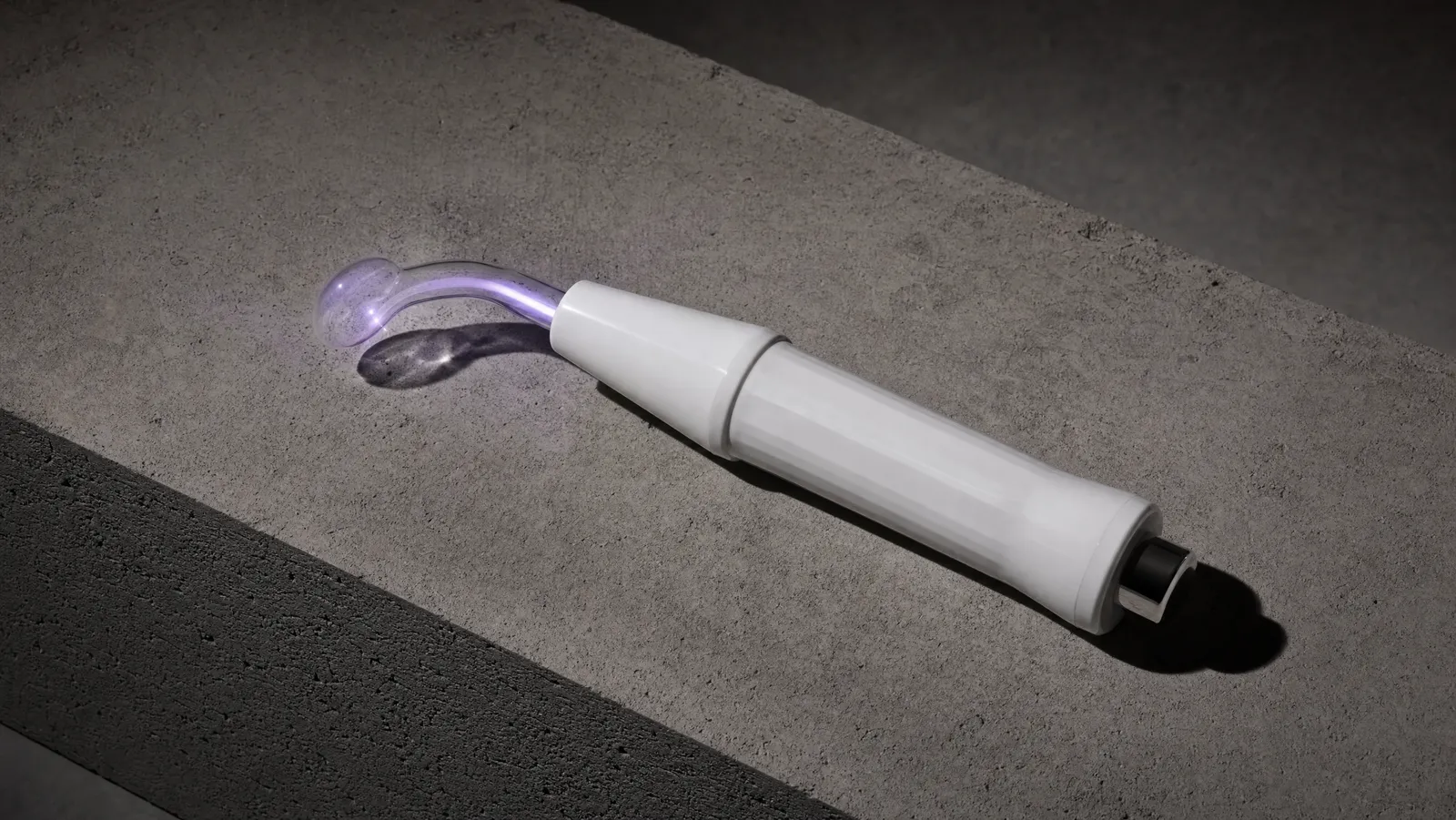
Here is the honest answer first. A high-frequency wand runs a high-voltage, low-current, rapidly alternating charge through a gas-filled glass electrode pressed against your skin. The spark makes a small amount of ozone at the glass surface, and in a petri dish that exposure kills the acne organism, with ozone the mechanism its researchers propose. Whether it clears congestion on a real face has barely been studied.
I'm Kelly Hyde, a certified skincare specialist, and this is the oldest thing in the at-home device categories that actually do something by roughly a century. Mine crackles and smells faintly like a laser printer left on too long. The first time I switched it on I had no idea whether I was doing something useful or something stupid, and that gap is why this page exists.
So: how to use a high-frequency wand, what the research supports, and the contraindications that are the real reason I wrote this.
What a high-frequency wand actually is
The hardware is Victorian. According to the cosmetic-history reference Cosmetics and Skin, the vacuum electrode later called the violet ray was "first developed by Frederick Finch Strong in 1896," and home models spread after the First World War. What you buy in 2026 is that object with the medical claims filed off: a coil that steps mains electricity up to high voltage at high frequency and very low amperage, plus a sealed glass tube you hold against your face.
The manufacturer description rewards close reading. The manual for a widely sold consumer wand, the NuDerma High Frequency Skin Therapy Wand from Pure Daily Care, says it "sends a low-level electrical current that passes through a glass electrode (also called a tube) filled with inert gas," and that "this electrical current creates enriched oxygen molecules and increases circulation."
"Enriched oxygen molecules" is marketing for ozone, the real byproduct. It is the only proposed mechanism with laboratory support behind it, and the one with an occupational exposure limit attached.
The claims have a track record. The US National Library of Medicine's archive of FDA Notices of Judgment includes case 4319, "Misbranding of Master violet ray devices", disposition "Plea of guilty. Fine of $2,000, plus costs." The hardware survived. The claims did not.
Argon vs neon: the color is the gas
The glowing color is a property of the gas sealed inside the tube. It is not a wavelength you dose your skin with, and not a setting you switch between.
Per Purdue University's chemistry gas discharge tubes demonstration sheet, an electrical discharge excites electrons in a low-pressure gas, and as those electrons fall back they emit light at wavelengths characteristic of that gas. Purdue's color table lists argon as violet, neon as red, helium as pink-orange. Cosmetics and Skin adds that most antique electrodes were "simply made with air in a partial vacuum," the vacuum setting the color.
| Electrode fill | Color you see | What listings claim | What a cited source says | |---|---|---|---| | Argon | Violet | Oily, congested skin | Purdue lists argon as violet. No source compares gases for a skin outcome | | Neon | Red to orange | Dry or mature skin | Purdue lists neon as red. No comparative data either | | Helium | Pink-orange | Rarely marketed | The fill used in the one in vitro study on these devices |
Read the right-hand column. Nobody has published a head-to-head comparison of argon against neon on human skin, so the argon-for-oily, neon-for-dry split on every product page is tradition, not evidence.
What the evidence actually supports
This category has been in use for roughly 130 years and studied surprisingly little. I would rather hand you that sentence than dress up esthetician practice as clinical proof.
The strongest modern work I found is laboratory work. In "High-frequency devices effect in vitro: promissing approach in the treatment of acne vulgaris?", published in Anais Brasileiros de Dermatologia in 2022, Frommherz and colleagues ran a portable high-frequency machine, fitted with "glass tubes filled with helium below atmospheric pressure," against cultured microorganisms.
The antimicrobial effect was real and fast. One minute of exposure significantly reduced most skin-flora species tested, Staphylococcus epidermidis by 83.43 percent and S. haemolyticus by 99.0 percent, while Micrococcus luteus from a forearm sample was not significantly reduced at all (3.1 percent, p = 0.5). Dermatophyte colonies fell 58.0 percent. Against the acne organism the paper names Propionibacterium acnes, colony counts fell from 7288.0 to 30.0 after one minute, p less than 0.001. Longer exposure kept helping to four minutes; eight added nothing.
Two findings matter for your own wand. Ozone accumulated over time, 0.015 ppm at ten minutes and 0.090 ppm at fifty, and the authors propose ozone-driven oxidative stress as the likely main antimicrobial mechanism. And no heat development was detected, which contradicts that manual's framing of high frequency as a device using "thermal energy."
Then the limits, in the authors' words: "The experiments were performed in vitro only," and "further in vivo studies are needed to prove efficacy and tolerability in a real-life setting." Their introduction notes the technique faded mid-century partly for "lacking data on efficacy."
Killing bacteria on a plate is not clearing a clogged pore, where sebum, dead cells and an intact follicle wall sit between the electrode and the organism. The circulation claim is thinner still: Cosmetics and Skin quotes a 1911 text asserting that "the fundamental value of high frequency currents is their beneficial effect on all nutritive processes." An assertion from 1911 is not a measurement.
So treat this as an optional adjunct some people find helps congestion, not as acne care. For congestion-prone skin the daily routine does the work, and mine is in my Korean routine for oily and acne-prone skin.
How to run a session
Reported as the manufacturer's instructions from that NuDerma manual, not a protocol of my own. Your wand's manual governs your wand. Read the contraindications further down before you switch anything on, because a few of them rule the device out altogether rather than asking you to be careful.
- Start on clean, dry skin. Step one is "thoroughly cleanse your skin and gently pat dry." Oily residue is a problem for reasons in the warnings below, so keep it simple: the double-cleanse method finished with a plain water rinse, using one of the gentle Korean cleansers I recommend.
- Insert the glass tube before the power goes on. The manual: "never power on the NuDerma before inserting one of the attachments," and tubes go in and out only while the device is off. Hold the tube by its metal base, never the tip, which is what breaks.
- Rest a finger on the tube, then switch on at the lowest setting. You "place one finger at the base of the glass tube," which "will prevent any small harmless static shocks." Beginners are told to stay at level 1 or 2, and that the system "is effective even at the lowest intensity setting."
- Make contact, then lift your finger. The sequence: "touch the glass tube's tip to your skin, remove your finger and glide the tube across your skin." Contact first, finger off second. That order keeps the spark off your fingertip.
- Add slip only if you need it. Two to three pumps of a water-based serum per section, in three or four sections. Water-based is not a preference. Oil-based and alcohol-based products are prohibited.
- Keep it moving, and keep it short. Small circular motions, "only 10-15 seconds maximum per area," and "keep the wand in motion while in use." With a spot tube you may "tap a blemish several times or keep the wand on it for 2-3 seconds." Avoid the eye area, eyelids and lips.
- Cap the session. Verbatim: "Limit NuDerma sessions to a maximum of 5 minutes every other day... to preserve the integrity of the gas inside the glass tubes." Read the stated reason twice: that cap protects the tube, not you, which tells you how much of this category's dosing guidance is engineering, not physiology.
- Finish and clean up. Massage in the residual serum and follow with moisturizer, or blot it off after unplugging. Clean the tube with a soft cloth and a little rubbing alcohol, device unplugged, and dry the glass fully before reuse.
One method note consumer kits quietly drop. Cosmetics and Skin describes two classical techniques: the direct method, where the operator moves the electrode over the face, and the indirect method, where "the client holds the saturator electrode while the operator massages the client's face." Indirect takes two people, which is why at-home wands are sold for the direct method only.
That five-minute ceiling is also why spacing a session around retinol and acids matters more than squeezing one in. An ozone-generating electrode has no business on skin you resurfaced an hour ago, and the manual's exclusion of abraded skin says the same in warranty language.
Who should not use one
Manufacturers and estheticians generally advise against high frequency for the groups below. These are reported warnings, not clearance to proceed. Check with your doctor.
Implanted electronic devices. This one is absolute. The NuDerma manual states: "Do not use NuDerma if you use a pacemaker, neuro-stimulator, ECG monitor, or any other type of implanted electronic device that is inside your body." There is no consult-your-doctor escape hatch in that sentence, unlike several others in the same list. For a body-worn device such as an insulin pump, it says consult your physician first.
Pregnancy. "Do not use NuDerma if you are or might be pregnant." If you are breastfeeding, it says consult your physician.
Heart conditions, blood pressure, seizure disorders. Verbatim: "If you have high or low blood pressure, a heart condition, epilepsy, or seizure disorders, consult your physician prior to use."
Metal in or near the area. Braces and permanent metal retainers send you to a dental professional first, and the manual recommends "removing any metal objects, such as jewelry, which may come in direct contact" with the device.
Broken, numb or inflamed skin. "Do not use NuDerma on any areas of skin that lack sensation or have swelling, bruising, cuts, abrasions or infections." It also rules out "active skin cancer or suspicious lesions," and sends anyone with a diagnosed skin condition to a dermatologist first. That is where rosacea and eczema land: a dermatologist conversation before the wand, not after.
Anything flammable, which is the rule most people break. "Never use NuDerma near combustible liquids or gasses, or with oil-based or alcohol-based products." A sparking electrode plus an alcohol-heavy toner, a facial oil, an aerosol or the hand sanitizer on your counter is a genuinely bad combination. The same manual bars wet hands, immersion and use near bathtubs or basins, and rules the device out for children and pets.
Never in the same session as microneedling. Freshly needled skin is punctured skin, which the manual already excludes as abraded, and no source supports introducing an ozone-generating spark to open channels. Where the home line sits for needling at all is its own guide.
One word on the ozone, since it is the mechanism. The CDC and NIOSH Pocket Guide entry for ozone lists a NIOSH ceiling limit of "C 0.1 ppm (0.2 mg/m3)" and an OSHA permissible exposure limit of "TWA 0.1 ppm (0.2 mg/m3)," with "irritation eyes, mucous membrane; pulmonary edema" among the symptoms and the respiratory system as a target organ. For scale, that 2022 paper measured 0.090 ppm after fifty minutes of continuous operation in its own test rig, which is not your bathroom. Against that measurement, a capped five-minute session in a ventilated room looks like a small exposure, though no one has measured it on a real face. Still: ventilate, and if you have asthma, raise it with your doctor first.
What it will not do
It will not lift or tighten. No published source shows energy from these wands reaching muscle or dermis, and the 2022 paper detected no heat development from the device it tested. For lifting, that is a different aisle: microcurrent vs RF vs ultrasound.
It will not oxygenate your skin. Those "enriched oxygen molecules" are ozone at the glass, not oxygen delivered into tissue, and no source supports an oxygenation claim.
It is not an FDA-approved anything. These wands sell as cosmetic devices, and per the FDA's consumer update Is It Really "FDA Approved?", "cosmetic products and ingredients, and their labeling, do not require FDA approval." And what a device clearance does and does not cover is worth knowing before you read any beauty-device listing: the FDA describes 510(k) clearance as a showing that a device is "substantially equivalent to a legally marketed predicate device," while premarket approval for its highest-risk class requires "sufficient, valid scientific evidence" of safety and effectiveness. The FDA's own page on checking whether a device has been cleared adds that "only a small percentage of 510(k)s require clinical data to support a marketing clearance." Clearance is a comparison against a device already on the market, not a finding that a product works as advertised.
Nobody has properly studied what it does for congestion. Not a gap in my research. A gap in the literature.
If what you want is the flushed, less-puffy look people describe after a session, a gua sha tool carries less risk and no electricity, and the structural gains come from a consistent anti-aging routine.
Frequently asked questions
Does a high-frequency wand help acne? The only modern evidence is laboratory evidence. In the 2022 Anais Brasileiros de Dermatologia study, one minute of exposure dropped colony counts of the acne organism from 7288.0 to 30.0, with ozone-driven oxidative stress proposed as the mechanism. The authors also wrote that "the experiments were performed in vitro only." Acne is a medical condition, and a dermatologist has better tools.
How long should a session be? Per the NuDerma manual, "limit NuDerma sessions to a maximum of 5 minutes every other day," with "only 10-15 seconds maximum per area" and the wand kept in motion. The stated reason for that cap is to "preserve the integrity of the gas inside the glass tubes." Follow your device's instructions.
Argon vs neon: which should I buy? On the available evidence it does not matter. Purdue's table lists argon as violet and neon as red because a discharge excites electrons that emit at wavelengths characteristic of each gas. I found no study comparing gases for a skin outcome, and the 2022 study's device used helium tubes, a gas almost nobody markets.
Can I use it with retinol, vitamin C or an acid toner? Not in the same session. The manual prohibits use "with oil-based or alcohol-based products" and excludes skin with cuts or abrasions, and plenty of acid toners are alcohol-carried. Keep the wand as its own step on clean, dry, intact skin.
The actual takeaway
The reader I wrote this for has a wand in a drawer and a jar of glycolic pads next to it. Keep the wand if you enjoy it. Move the pads.
The record, compressed: the device is 130 years old, its antimicrobial effect is documented in a dish and nowhere else, its ozone byproduct is a respiratory irritant with a published exposure ceiling, and its most important warning is the one about implanted electronic devices. Everything else is tradition, and tradition deserves a smaller place in your routine than the cleanser you use nightly.
For the categories with better evidence behind them, start with Next Gen Beauty's at-home device roundup.
About the Author
Kelly Hyde
Kelly Hyde is a certified skincare specialist and beauty trend forecaster, and the founder of Next Gen Beauty Reviews. She spends her time testing the latest K-beauty launches, at-home beauty devices, and skincare tools so you do not have to, and only recommends products she would put in her own routine.