The Best Microcurrent Facial Devices, Judged on Their Own Spec Sheets

My jaw does a thing in photographs now that it did not do at 29. That is the entire market for microcurrent in one sentence. The device I keep reaching for is the NuFACE TRINITY+, but the single most useful thing I can tell you before you spend anything is that the gel is effectively a subscription. Some links below are affiliate links — if you buy through them I may earn a small commission at no cost to you.
This is the microcurrent chapter of my wider guide to the best at-home beauty devices, and I wrote it off the spec sheets instead of the marketing copy. Choosing the best microcurrent facial device comes down to four things: the intensity count, what the FDA clearance on the box does and does not mean, whether the conductive gel is included or quietly assumed, and where the published research actually sits. Prices run from about $80 for a bottle of gel to $495 for the top-end handset as of October 2026, and the cards below carry the current price for each.
How to choose a microcurrent facial device
- Count the intensity levels and ignore the word "power." None of the five listings here prints a microamp output figure, so the number of selectable intensities is the output spec you can most reliably compare across devices. Both the FOREO BEAR mini and the NuFACE MINI+ in the Hydrate + Sculpt set list three intensities, which gives you a low setting for thin skin and a higher one along the jaw and neck.
- Ask whether gel is included, not just whether it is required. Microcurrent will not run on dry skin. The NuFACE Hydrate + Sculpt set bundles the Aqua Gel Activator; the standalone 10 oz IonPlex bottle is $80 as of October 2026. The INIA SPHERA listing says gel is recommended, and nothing in the FOREO BEAR mini's listed specs covers a conductive medium, so budget for one.
- Understand what "FDA-cleared" means before you pay for it. Four of the five items here list an FDA clearance in their specs; the INIA SPHERA listing does not claim one. According to the FDA, a 510(k) clearance is a comparative review that shows a device is substantially equivalent to a legally marketed predicate device, and the FDA says it is inappropriate to describe a cleared product as "FDA approved." Clearance is a market-access decision, not a verdict on whether your jawline will change.
- Decide if you want one job done or eight. The INIA SPHERA integrates eight technologies across five modes, including microcurrent, red LED, thermal frequency, electroporation infusion and cryo cooling, per the manufacturer. That is genuinely convenient, and it also means microcurrent is one-eighth of what the handset was designed to do.
- Look for contact or resistance sensing. FOREO says the BEAR mini scans and measures your skin's resistance to electricity and adjusts its own microcurrent intensity, which is the anti-shock feature in its spec sheet. INIA says the SPHERA's smart sense technology activates only on direct skin contact. Both are small comfort features that make a device less likely to sit in a drawer.
- Pick the session length you will actually repeat. The TRINITY+ red light attachment runs a 3-minute session, per NuFACE. Short beats thorough here, because microcurrent results are maintenance results. A handset you use twice and abandon is the most expensive option on this page.
How microcurrent actually works
Microcurrent is low-level electrical stimulation applied through two electrodes you glide over gelled skin. The name is literal: according to a review of microcurrent dressings indexed in PubMed Central, the currents used in this research sit in the microampere range, on the order of 70 to 300 microamps. According to a 2022 review in the European Journal of Applied Physiology, microcurrent means current of 1 to 999 microamps, and electrical currents of this magnitude are insufficient to excite motor nerves. That is why a session feels like almost nothing, and occasionally like a faint metallic tang at the back of your teeth.
Where the evidence is strongest is not faces. According to a meta-analysis of randomized clinical trials indexed on PubMed, adding microcurrent therapy to standard wound care reduced wound area and healing time, but the authors rated the certainty of evidence moderate for wound area and low for healing time, and called for future trials designed to lower the risk of bias. A systematic review of microcurrent in tissue healing and scar modulation, registered in PROSPERO and indexed on PubMed, covers healing rate, time to closure and scar thickness and pliability. Those are wounds and scars, not nasolabial folds, and it is more respectful of your money to say so than to borrow the credibility.
The mechanism story is plausible and mostly preclinical. According to a 2025 review of electrical stimulation for wound healing indexed in PubMed Central, electrical stimulation appears to increase collagen synthesis and angiogenesis, which is how it is thought to speed wound closure. An older review of microcurrent dressings reports that direct current increased collagen synthesis in a porcine excisional wound model, and a systematic review on electrical stimulation in burn recovery reports that stimulation may shorten the inflammatory phase and shift collagen from type III toward type I during remodeling. Interesting, directionally encouraging, and a long way from a human facial-contour trial. No published study shows a handheld microcurrent device building collagen in facial skin, so read all of that as mechanism, not as a result to expect from a wand.
Gel is physics, not an upsell. Skin is a poor conductor when it is dry. According to FDA 510(k) records for conductive gels, these gels reduce the impedance of the electrode-to-skin contact and help distribute current evenly, which is exactly the job your microcurrent device needs done. Run a device dry and you are not getting a gentler treatment, you are getting a worse one.
Read the manufacturer claims as claims. NuFACE says the MINI+ delivers FDA-cleared microcurrent at three intensities to tone, lift and visibly contour more than 69 facial and neck muscles. That is the maker's language, and the word doing the work is "visibly." No at-home handset makes a permanent anatomical change to a muscle. What these devices may do is improve the appearance of contour and firmness for as long as you keep using them, which is also why every honest review of this category ends with the word "maintenance."
Our top picks at a glance
My Top Pick is the NuFACE TRINITY+, the only device here that pairs FDA-cleared microcurrent with a separate 34-LED red light attachment. If you want the cheapest honest way in, the FOREO BEAR mini is the one that measures your skin's resistance and adjusts its own output, and it sits around $120 as of October 2026 against a $219 list price. If you would rather buy the device and the gel together and be done, the NuFACE Hydrate + Sculpt set bundles the MINI+ with the Aqua Gel Activator, three masks, an applicator brush and a travel case. The INIA SPHERA is the pick for people who want five modes in one handset. Full reviews, current prices and buy buttons for all five are in the cards directly below this guide.
The five picks, and who each one is for
NuFACE TRINITY+ (Top Pick). This is the reference device, and at $495 as of October 2026 it is roughly four times the price of the cheapest handset here. Two features live in one body and should be judged separately. The microcurrent is the part NuFACE describes as FDA-cleared and aesthetician-developed, backed by what the brand calls 20 years of expertise, and it needs conductive gel. The light attachment is a different thing entirely: NuFACE says 34 precision LEDs deliver a calibrated trio of red, amber and infrared light in a 3-minute session, and that no gel is needed for the red light therapy. Do not let the box blur those two into one claim, because the clearance NuFACE cites attaches to the microcurrent.
FOREO BEAR mini (Best Value). Around $120 as of October 2026, down from a $219 list, and it is the device I would hand someone who is not sure they will stick with this. FOREO says it combines three microcurrent intensities with T-Sonic pulsations, that two spheres channel the energy into the skin, and that it scans and measures the skin's resistance to electricity and automatically adjusts intensity. It carries a 2-year warranty per the listing. It is also pocket-sized in a way the NuFACE handsets are not, which matters more than it sounds.
NuFACE Hydrate + Sculpt Gift Set (Best Starter Kit). Six pieces for about $199 as of October 2026: the MINI+ device at three intensities, the Aqua Gel Activator, a Hydra-Gel Power Mask, an applicator brush and a travel case, with NuFACE noting three masks for use between microcurrent sessions. The arithmetic is the whole argument. The gel alone is $80 as of October 2026, so bundling it with the device is the version of this purchase that does not come with a second bill a week later.
INIA SPHERA (Best Multi-Function). About $180 as of October 2026 against a $234 list. INIA says it integrates eight beauty technologies, including red LED light, microcurrent, thermal frequency, needle-free electroporation infusion, cryo cooling and vibration massage, across five modes, and that mode 5 cools down to 15 to 16 degrees Celsius, or 59 to 61 Fahrenheit. That cryo floor is the most interesting number on its sheet: genuinely cold metal on a puffy morning face is an immediate, non-controversial effect. Two caveats: its listing does not claim an FDA clearance, and a handset built to do eight things is not optimized for any one of them.
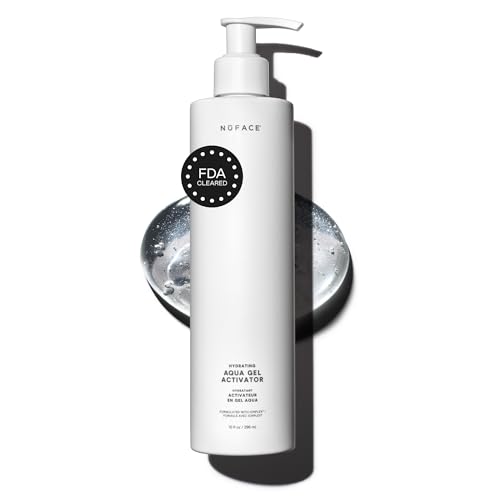
NuFACE IonPlex Aqua Gel Activator (The Gel You Actually Need). Not a device, and in the roundup on purpose. NuFACE says it conducts the microcurrent from the device down to the facial muscles and that it fits the Mini, Trinity, MINI+, TRINITY+ and NuBODY. The 10 oz bottle is $80 as of October 2026, is listed as FDA-cleared, claims hydration for up to 24 hours, and is formulated with hyaluronic acid and glycerin, with NuFACE adding that hyaluronic acid can hold up to 1,000 times its weight in water. Per the listing it is free of parabens, phthalates, mineral oil and added fragrance.
Why three of these five picks are NuFACE
I want to be straight about the line-up, because a roundup where three of five picks share a logo deserves an explanation. Nobody paid for placement. NuFACE simply has the longest run in this category: according to FDA 510(k) records indexed in public clearance databases, the brand's devices sit in product code NFO, transcutaneous electrical stimulators for aesthetic purposes, a Class II category, with clearances going back well over a decade. It is also the brand whose conductive gel is in this line-up on a listing of its own, which is why a gel bottle could earn a slot at all. FOREO sells a conductive serum for its BEAR devices as well, so the consumable is not a NuFACE-only expense.
The flip side is lock-in: buying into NuFACE means buying into NuFACE's consumable. That is a reasonable trade for the track record, but it is a trade. FOREO recommends its own conductive serum for BEAR devices while its listings also allow other conductive gels, and the INIA listing only says gel is recommended, so the FOREO and INIA picks are here for people who would rather not be tied to a single bottle.
The gel is the real running cost of at-home microcurrent devices
Every review of this category talks about the handset and skips the bottle. An $80 consumable changes the shape of the decision: a $120 device is not really a $120 device, and the $199 bundle is closer to the true floor than its sticker suggests. If you want one piece of buying advice from this guide: price the device plus a year of gel, then compare.
How long a bottle lasts depends entirely on how generously you apply it and how often you run a session, and I am not going to invent a figure. What I will say is that the NuFACE IonPlex Aqua Gel Activator is the one NuFACE specifies for its own devices, and the general rule with any electrical device is that the manual, not the internet, is the authority on what you are allowed to put between the electrode and your skin.
Microcurrent for the jawline, and what it will not do
The jaw and the neck are where almost everyone shopping for a microcurrent device for the jawline is hoping to see something. It is also the area where the manufacturer language gets most ambitious: NuFACE's claim is contouring more than 69 facial and neck muscles. I write separately about whether microcurrent actually works, and the honest summary is that the peer-reviewed literature on microcurrent is mostly about wounds, scars and tissue healing rather than facial contour, so the fair expectation is a temporary improvement in the appearance of definition, not a structural change.
Here is what I would not buy one of these for. It will not remove established skin laxity, it will not substitute for the things with the strongest evidence behind them, and it will not survive neglect: the effect is maintained by continued use, not banked. If your goal is long-term firmness, the boring stack of a retinoid, daily sunscreen and a consistent anti-aging routine is the part of this with the strongest published evidence behind it, and probably doing more of the heavy lifting than any handset. Microcurrent is the thing you add on top for the way your face looks on a Thursday evening.
Who should skip microcurrent
This is the section the glossy listicles leave out. NuFACE's own published use instructions say not to use the device if you have an electronic implanted device such as a defibrillator, neurostimulator, pacemaker or ECG monitor, and not to use it if you have a history of epilepsy or seizures. An esthetics electrotherapy study guide lists cardiac pacemakers and other implanted electronic devices, seizure disorders and pregnancy as absolute contraindications for microcurrent treatment. Device-maker FAQs and professional electrotherapy references also flag broken or inflamed skin, active infection, metal implants in the treatment area and recent injectables as reasons to avoid or delay a session.
None of that is medical advice and I am not your clinician. Read the manual that ships with your device, treat its warnings as the floor rather than the ceiling, and if any of the above applies to you, ask the relevant professional first. If you have had filler or a neuromodulator recently, the person who injected you is the right person to ask about timing.
Where microcurrent fits with everything else
Microcurrent plays well with the rest of a device drawer if you are clear about what each tool is for. An LED face mask is the modality most people weigh it against, and the two are not really competitors: light therapy is passive and cumulative, microcurrent is active and immediate. For the manual version, without the electricity or the consumable, a gua sha tool costs a tiny fraction of the price, and it is what I would try first if the $80 gel line item made you wince. And if you already keep a beauty fridge, a cold serum straight after a session is a pleasant finish, though it is a nicety rather than part of the treatment.
Frequently asked questions
Do at-home microcurrent devices work? They may help improve the appearance of facial contour and firmness while you use them consistently, and the manufacturers' own language ("visibly contour," "tone") is careful for a reason. The published microcurrent research with the strongest designs is about wound healing and scar modulation rather than facial aesthetics, and even there a meta-analysis of randomized trials rated certainty moderate for wound area and low for healing time. Buy one because you enjoy the few minutes it takes and like what you see in the mirror afterward, not because you expect a clinical outcome.
Is "FDA-cleared" the same as "FDA-approved"? No, and the difference matters. A 510(k) clearance means the FDA agreed the device is substantially equivalent to a predicate device already on the market; the FDA explicitly says a cleared product should not be called "FDA approved," which is reserved for devices that went through premarket approval and independently demonstrated safety and effectiveness. Every microcurrent device in this guide that claims a regulatory status claims clearance, not approval.
Do I actually need the conductive gel? Yes. According to FDA 510(k) records for conductive gels, the gel reduces the impedance between the electrode and your skin and helps the current spread evenly, so skipping it does not give you a gentler session, it gives you a worse connection. Use the medium your device's manual specifies rather than improvising with whatever serum is open.
How often should I use one, and how long until I see anything? Follow the schedule in your device's manual, since that is the only instruction with real authority behind it and the brands differ. The structural point is that microcurrent is a maintenance habit: whatever you like is sustained by continuing and fades when you stop. Judge a device on whether you are still using it in six weeks.
Microcurrent or an LED mask, if I can only buy one? If your priority is the look of a sharper jaw and cheekbone on a given day, microcurrent is the more satisfying purchase, and the TRINITY+ gives you both modalities in one body. If your priority is fine lines and overall tone and you would rather sit still than glide a handset around for a few minutes, start with an LED face mask instead, and note that light therapy has no $80 consumable attached.
If you want my one recommendation, it is still the NuFACE TRINITY+: the longest track record in the category, the separate 34-LED red light attachment for the nights you cannot be bothered with gel, and the spec sheet that is easiest to hold the brand to. If $495 is not the conversation you want to have, the BEAR mini and the Hydrate + Sculpt bundle are honest entry points, and the gel is the line item to plan for either way. Compare the prices in the cards below, then head back to our complete at-home device guide to see how microcurrent stacks up against LED, radiofrequency and the rest of the drawer.
The Shortlist
Top 3
NuFACE TRINITY+ Facial Sculpting Device with LED Red Light Wrinkle Reducer
- Modality
- Microcurrent + LED
- Clearance
- FDA-cleared
- LEDs
- 34 precision LEDs

FOREO BEAR mini Microcurrent Facial Device
- Modality
- Microcurrent + T-Sonic
- Clearance
- FDA cleared
- Intensities
- 3

NuFACE Hydrate + Sculpt Microcurrent Facial Device Gift Set, 6 Piece
- Modality
- Microcurrent
- Clearance
- FDA-cleared
- Intensities
- 3
The Reviews
01—05NuFACE TRINITY+ Facial Sculpting Device with LED Red Light Wrinkle Reducer
The reference standard, and the only device here that pairs FDA-cleared microcurrent with a 34-LED red light attachment.
- Modality
- Microcurrent + LED
- Clearance
- FDA-cleared
- LEDs
- 34 precision LEDs
- Light session
- 3 minutes
- Wavelengths
- Red, amber, infrared
- Gel required
- Microcurrent only
The reference standard, and the only device here that pairs FDA-cleared microcurrent with a 34-LED red light attachment. Expensive, but it is the one with two decades of aesthetician development behind it.
FOREO BEAR mini Microcurrent Facial Device
The cheapest honest way into microcurrent, and the only one here that measures your skin's resistance and adjusts its own output.
- Modality
- Microcurrent + T-Sonic
- Clearance
- FDA cleared
- Intensities
- 3
- Safety
- Anti-shock resistance sensing
- Warranty
- 2 years
The cheapest honest way into microcurrent, and the only one here that measures your skin's resistance and adjusts its own output. Two spheres, three intensities, pocket-sized.
NuFACE Hydrate + Sculpt Microcurrent Facial Device Gift Set, 6 Piece
The MINI+ device bundled with the gel you are going to need anyway, plus three masks and a travel case.
- Modality
- Microcurrent
- Clearance
- FDA-cleared
- Intensities
- 3
- Pieces
- 6
- Muscles targeted
- 69 face + neck
The MINI+ device bundled with the gel you are going to need anyway, plus three masks and a travel case. Buying the gel separately costs $80, which makes this the sensible entry point.

INIA SPHERA Upgraded 8-in-1 Microcurrent Facial Device for Face & Neck
If you would rather own one handset than four, this stacks microcurrent, thermal frequency, red LED, electroporation and a genuinely cold cryo mode into five modes.
- Technologies
- 8, incl. microcurrent
- Modes
- 5
- Cryo floor
- 15-16 C / 59-61 F
- Contact sensor
- Activates on skin contact
- Gel
- Recommended
If you would rather own one handset than four, this stacks microcurrent, thermal frequency, red LED, electroporation and a genuinely cold cryo mode into five modes. Jack of all trades, and priced like it.
NuFACE IonPlex Aqua Gel Activator, Conductive Microcurrent Gel, 10 oz
Not a device, but the consumable nobody warns you about.
- Type
- Conductive microcurrent gel
- Size
- 10 oz
- Clearance
- FDA-cleared
- Hydration
- Up to 24 hours
- Key actives
- Hyaluronic acid, glycerin
- Fits
- Mini, Trinity, MINI+, TRINITY+, NuBODY
Not a device, but the consumable nobody warns you about. Microcurrent needs a conductive medium, and this is the 10 oz bottle that keeps a NuFACE running for months.
About the Author
Kelly Hyde
Kelly Hyde is a certified skincare specialist and beauty trend forecaster, and the founder of Next Gen Beauty Reviews. She spends her time testing the latest K-beauty launches, at-home beauty devices, and skincare tools so you do not have to, and only recommends products she would put in her own routine.