The Best Scalp Scrubs and Exfoliating Treatments

Most people do not need a scalp scrub, and the ones who do usually know exactly why. A scalp scrub is for product buildup, excess oil, and the heavy, coated feeling at your roots that shampoo stops fixing. The best scalp scrub for you depends on whether you need physical grit, like salt or sugar, or a chemical exfoliant such as salicylic acid. My pick for most people is the NatureLab.TOKYO Perfect Clean Scalp Scrub. Some links below are affiliate links — if you buy through them I may earn a small commission at no cost to you.
I bought my first one for the wrong reason. I had flakes, I assumed flakes meant dirty, and I spent two months scrubbing a scalp that was actually irritated. Below: what physical and chemical exfoliants do, the criteria worth shopping on, how to use one without wrecking your scalp barrier, and when a scrub is the wrong tool. It is a once-every-week-or-two step, so it only earns its place inside a sensible week — read it next to my best hair care routine framework.
Physical scrubs vs. chemical exfoliants
Two different products share one category name, and picking the wrong one is how most people waste money.
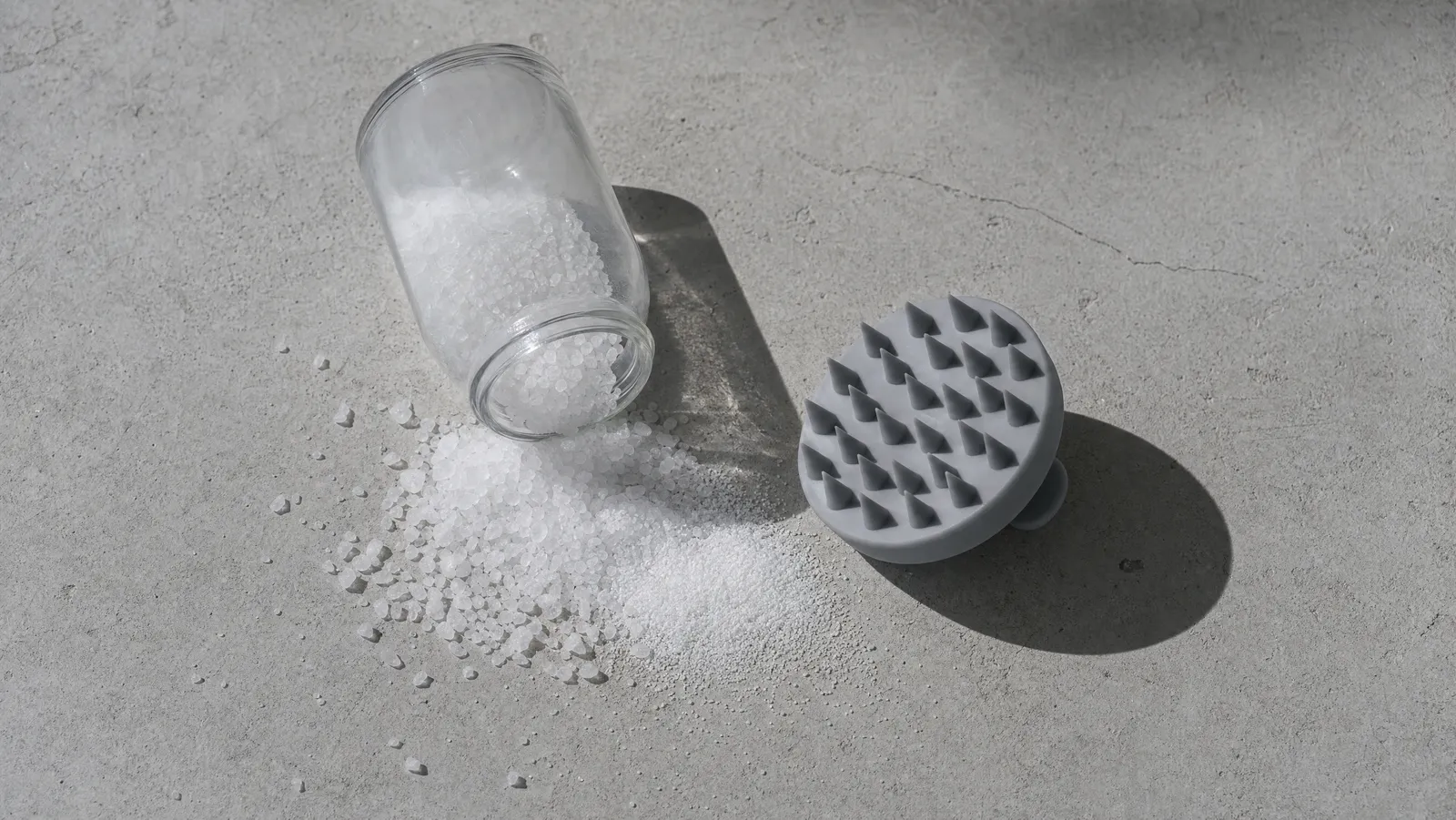
Physical scrubs suspend particles — nearly always salt or sugar — in a paste, oil or foam you work across the scalp, lifting loose flakes, styling residue and oil mechanically. You can feel them working, which is most of the appeal and also the risk: pressure does the job, and pressure is easy to overdo.
Chemical exfoliants do not scrub anything. Salicylic acid, the one you will see most often, is a beta hydroxy acid that loosens the bonds between dead surface cells so scale releases on its own. According to StatPearls on the NCBI Bookshelf, it is used topically for its keratolytic effects, and Cleveland Clinic describes salicylic acid shampoo as a medication that breaks down layers of thick skin on your scalp. No abrasion, which is why this format suits adherent flaking — the tight, stuck-down kind a sugar scrub skates over.
Salicylic acid is oil-soluble, and that matters on an oily scalp. According to a chemical peel review on PubMed Central, salicylic acid peels showed better sustained efficacy and fewer side effects than glycolic acid in acne, which the authors attributed to salicylic acid's greater lipophilicity. In plain terms: it mixes with sebum instead of being repelled by it, so it works into an oily follicle rather than sitting on top.
Salt and sugar do not behave the same way. Sugar crystals dissolve on contact with warm water and fingertips, so the abrasion tapers off quickly and the product becomes a wash. Salt holds its edges far longer, which is what people mean when a salt scrub feels more thorough — and why it stings a scalp that is scratched, picked at or sore. Innersense states on its own listing that its True Enlightenment Scalp Scrub is not recommended for sensitive scalps, and peppermint oil is a big part of why.
How to choose a scalp scrub
- Start with the problem, not the format. Greasy roots and a coated feeling from dry shampoo, gel or leave-in point to a physical scrub or clarifying wash. Tight, adherent scale that will not brush away points to a chemical exfoliant. Flaking that returns within days is a third thing entirely, covered below.
- Particle type and size. Sugar is gentler because it dissolves as you work; salt stays abrasive longer and suits a durable, oily scalp better than a reactive one. Some products skip particles altogether: Amika's Reset is an oil-to-foam pre-wash, and the brand claims its charcoal and pink clay draw out buildup, dirt and oil without stripping.
- Does it replace your shampoo or sit before it? NatureLab.TOKYO's is a scrub and clarifying shampoo in one bottle, and the brand directs using it one to two times a week in place of regular shampoo — the version most people stick with. A pre-wash treatment is an extra step.
- Your hair length and density. The criterion people underestimate. Loose salt grains in hair past your shoulder blades are a rinsing problem — you will find grit at your nape hours later. Long, thick or tightly textured hair does better with a foaming format — the Tea Tree Special Detox scrub foams as you work it, so it rinses more like a shampoo than a paste.
- Scalp sensitivity. If your scalp flushes, stings or itches easily, skip peppermint, menthol and high-fragrance formulas and consider a no-grit option. There is no prize for using the harshest product you can stand.
- Cost per use. You use a scrub every week or two, not daily, so a jar lasts and sticker price matters less than it looks. The picks here run from about 16 dollars to about 54 dollars as of September 2026 — and the cheapest is the one I recommend most often.
How to use one properly
Get your scalp genuinely wet first. Not damp. A saturated scalp spreads product, cushions the grit and prevents dragging.
Work in sections along your part. Apply a line of product to the exposed scalp, move the part an inch, repeat. Product left on top of your hair stays there. The AAD makes the same point about shampoo: apply it to your scalp rather than the entire length.
Fingertips only, never nails. Flat pads, small circles. Nails scratch, and a scratched scalp is the one thing you cannot exfoliate your way out of.
Sixty seconds, not three minutes. Gentle pressure for a minute does the work; longer and harder just abrades more. If you are leaning in hard, the product is not right.
Rinse for longer than feels necessary, head tipped back so residue runs away from the scalp. Then condition the lengths, not the roots: the AAD suggests conditioner on the ends if your hair is fine or straight, and along the full length if it is dry or curly.
Skip it on a scalp that is broken. Sore, scratched, sunburned or inflamed skin does not need exfoliation. Do not use a scrub the same day as any other exfoliating or medicated scalp treatment — stacking actives is how mild irritation becomes real irritation.
Our top picks at a glance
My overall pick is the NatureLab.TOKYO Perfect Clean Scalp Scrub at about 16 dollars as of September 2026: sugar crystals, a clarifying shampoo in the same bottle, and a brand claim of being sulfate-free and color-safe. If grit is the problem — reactive scalp, or hair long enough to trap it — the Amika Reset Pink Charcoal Scalp Cleansing Oil is the no-particle alternative. For stubborn, adherent flaking rather than ordinary buildup, the Keralyt 5 Salicylic Acid Shampoo is the chemical exfoliant here — a 5 percent acid is a real step up in strength, so follow the label rather than a schedule you read online. Full details and current prices are in the cards below.
How often should you use one
Every one to two weeks covers most scalps. Less often if your hair is dry, your scalp is sensitive, or your hair is tightly textured and fragile at the roots. More often only with a specific reason — heavy styling products, a sweaty job, a swimming routine — and even then it means weekly, not every wash.
Here is the trap. Your scalp is skin, with the same barrier and oil glands as your face. Strip it too often and it can answer with more oil and more visible flaking, which reads as "I need to scrub again" and starts the loop over. The person scrubbing hardest is often the person making it worse. If your scalp feels tight after a wash and greasy within a day, back off for a month before buying anything else.
Wash frequency drives all of this, since a scrub lives on a wash day. Someone who washes daily and someone who washes every ten days mean very different things by "every other week," which is why I would settle how often you should wash your hair first.
When a scrub is the wrong tool
This is the part that matters most: if your flaking comes back within days of washing, it is probably not buildup, and a scrub is not the answer.
Dandruff may be considered the mildest form of seborrheic dermatitis, according to the American Academy of Dermatology, and it is not a hygiene problem. The AAD lists yeast that lives on everyone's skin, and sebum, among the things that play a role, says people with the condition may have developed a reaction to that yeast, notes that the exact cause is unknown, and states plainly that it is not caused by unclean skin. Cleveland Clinic names that yeast as Malassezia and describes a skin reaction that happens when there is too much of it, and the AAD notes that seborrheic dermatitis causes inflammation while dandruff does not. Either way the flaking is a skin reaction rather than a layer of dirt, so scrubbing does nothing about the cause and can irritate the skin further. The AAD's treatment guidance runs to dandruff shampoos, prescription options like ciclopirox, and a maintenance shampoo to prevent flare-ups: a chronic condition you manage, not a mess you buff off.
Psoriasis plaques are not buildup either. Cleveland Clinic describes scalp psoriasis as a chronic autoimmune disease in which new skin cells reach the surface every three to four days instead of every 28 to 30, producing raised, discolored plaques with a silvery surface of dead cells, and warns that scratching them may worsen the associated hair loss.
None of that makes a scrub bad. It makes it a tool for residue and oil, pointed at the wrong problem constantly. Persistent flaking, redness, soreness, bleeding or hair loss deserves a board-certified dermatologist, not a fifty-dollar jar of salt. That goes double before you reach for a 5 percent salicylic acid product like the Keralyt 5: an over-the-counter option for stubborn adherent flaking, and a real step up in strength from a cosmetic scrub. Follow the label, and talk to a dermatologist before self-treating a scalp condition that keeps returning. Cleveland Clinic's general guidance on salicylic acid shampoo is not to use it more often than directed, and it notes the ingredient can increase sun sensitivity.
Where exfoliation fits in a scalp routine
Scalp care has four jobs: cleanse, exfoliate, treat, protect. Cleansing happens every wash. Treating — serums, medicated shampoos, anything your dermatologist gave you — happens on the schedule it was prescribed. Protecting is sunscreen on a visible part and less tension on your hairline. Exfoliating is the step you do least often, and that is the point.
The wash-day sequence is simple. Scrub first, on a soaking-wet scalp. If your scrub is not also a shampoo, shampoo afterward to clear the loosened residue. Then conditioner or a mask on the mid-lengths and ends, never back into the roots you just cleared. Everything else in your week matters more than the scrub does, which is why I would build a proper scalp care routine first and add exfoliation to it. And since conditioning is where the visible payoff lives, the best hair masks for damaged hair make a better companion than a second scrub does.
Buildup, porosity, and why residue collects
Two people can use the same product and have completely different experiences of it. Fine hair carries more surface area for its mass, so the same leave-in coats it more heavily and shows up sooner as limpness at the roots. Low-porosity hair, with its tightly packed cuticle, resists absorbing what you put on it, so more of that product stays on the surface where you can feel it. That is a pattern stylists describe rather than a lab measurement, but it is why "use less product" lands differently for different heads — and why it is worth understanding hair porosity before you decide your problem is buildup.
Your water matters too, and here the evidence is more concrete. According to research indexed on PubMed, scanning electron microscopy of hair washed in hard water showed a ruffled surface with higher mineral deposition and decreased thickness than hair washed in distilled water, with measurably more calcium and magnesium left on the fiber. Add heavy stylers, dry shampoo and silicone-rich leave-ins, and the coated feeling arrives faster than your wash schedule can clear it. A scrub every week or two is a reasonable answer; a filtered shower head is the less glamorous one.
Scrubs, massage, and hair growth
Exfoliating and massaging your scalp feels wonderful, and keeping the surface clear is sensible. What it does not do is change what a follicle produces: density, texture and growth rate are set below the skin, and nothing you rub on top rewrites that.
The scalp massage claim deserves a straight answer, because it is repeated everywhere. The most-cited evidence is a 2016 Eplasty study in which nine healthy men used a standardized massage device on one side of the scalp for four minutes a day over 24 weeks, and hair thickness increased on the massaged side. Nine men, one study, a device rather than fingers, thickness rather than count. A 2019 paper in Dermatology and Therapy surveyed 340 people about twice-daily standardized scalp massages, and 68.9 percent reported that their hair loss had stabilized or that hair had regrown — self-reported and uncontrolled. The honest summary: the evidence is limited to small, low-quality studies, so massage may help some people and I would not promise it to anyone. If growth is your goal, the fundamentals in a hair care routine for hair growth are a better use of your attention than a jar of salt, and sudden shedding is a dermatologist conversation.
Frequently asked questions
Can you use a scalp scrub on colored hair? Usually, if you choose carefully. Clarifying formulas are built to strip residue and color can come along for the ride, so look for products that state they are color-safe. NatureLab.TOKYO says its scrub is sulfate-free and safe for color-treated hair.
Does a scalp scrub help dandruff? It can temporarily remove visible flakes, but it does not address why they keep forming. The AAD attributes seborrheic dermatitis to factors including a reaction to yeast that lives on everyone's skin, and to sebum, and directs people to dandruff shampoos and, when those fall short, prescription treatments. If flaking returns within days, see a dermatologist.
Can you make your own with sugar and conditioner? You can, and it is the least bad DIY version — sugar dissolves quickly, conditioner gives it slip — but there is no preservative system, so mix it fresh. The kitchen-salt-and-coconut-oil recipe is worse than it sounds: table salt grains are irregular and sharp-edged rather than cosmetically graded, and coconut oil is hard to rinse out, so you finish with oily residue at the roots — the exact problem you set out to solve.
Do you shampoo after a scalp scrub? Depends. If the scrub is also a shampoo, as NatureLab.TOKYO's is, you are done. If it is a pre-wash or an oil-based scrub, shampoo afterward, or you have loosened the residue without removing it.
Can you use one on dry hair? Not the physical ones. Dry hair means no cushion and no slip, so grit drags across the skin and abrades rather than exfoliates. Wet the scalp thoroughly first. Some pre-wash oils are designed for dry or damp hair — follow the label.
Is a silicone scalp brush enough on its own? For a lot of people, yes. A soft brush used gently while you shampoo lifts residue without abrasive particles, at a fraction of the cost. It will not do what a chemical exfoliant does on adherent scale, and scrubbing hard with one is as irritating as using your nails.
The short version: buy the NatureLab.TOKYO Perfect Clean Scalp Scrub, use it every week or two in place of your normal shampoo, and judge it by how your scalp feels two days later rather than two minutes later. Calmer scalp, roots that stay light for longer — right tool. Tight, itchy or flaky again by midweek — stop scrubbing and talk to a dermatologist. Either way, put the effort into the everyday steps in our hair care routine guide, where nearly all of the real results come from.
The Shortlist
Top 3
NatureLab.TOKYO Perfect Clean Scalp Scrub & Clarifying Shampoo
- Size
- 8.1 oz
- Type
- Physical scrub + shampoo
- Exfoliant
- Sugar crystals

Amika Reset Pink Charcoal Scalp Cleansing Oil
- Size
- 6.7 oz
- Type
- Pre-wash cleansing oil
- Exfoliant
- None (clay/charcoal binding)

Tea Tree Special Detox Foaming Salt Scrub
- Size
- 6.5 oz
- Type
- Foaming physical scrub
- Exfoliant
- Salt
The Reviews
01—06NatureLab.TOKYO Perfect Clean Scalp Scrub & Clarifying Shampoo
A sugar-crystal scrub and clarifying shampoo in one bottle, which is the format that actually survives contact with a real wash day.
- Size
- 8.1 oz
- Type
- Physical scrub + shampoo
- Exfoliant
- Sugar crystals
- Best for
- Most scalps, color-treated hair
A sugar-crystal scrub and clarifying shampoo in one bottle, which is the format that actually survives contact with a real wash day. The brand says it lifts buildup, excess oil and product residue while hyaluronic acid and sake water keep the scalp from feeling stripped, and that it is sulfate-free and safe for color-treated hair.
Amika Reset Pink Charcoal Scalp Cleansing Oil
An oil-to-foam pre-wash for anyone whose scalp cannot tolerate physical grit, or who has hair long enough that salt particles turn into a rinsing problem.
- Size
- 6.7 oz
- Type
- Pre-wash cleansing oil
- Exfoliant
- None (clay/charcoal binding)
- Best for
- Sensitive scalps, long hair
An oil-to-foam pre-wash for anyone whose scalp cannot tolerate physical grit, or who has hair long enough that salt particles turn into a rinsing problem. Amika says the charcoal and pink clay draw out buildup, dirt and oil without stripping.
Tea Tree Special Detox Foaming Salt Scrub
A salt scrub that foams as you work it in, so it distributes and rinses more like a shampoo than a paste.
- Size
- 6.5 oz
- Type
- Foaming physical scrub
- Exfoliant
- Salt
- Best for
- Oily scalps, heavy product users
A salt scrub that foams as you work it in, so it distributes and rinses more like a shampoo than a paste. The brand positions it as removing product buildup, excess oil and sebum from the scalp.

Innersense Organic Beauty True Enlightenment Scalp Scrub
Hawaiian red salt, apple extract and peppermint oil, for the reader who shops by ingredient list.
- Size
- 6.7 oz
- Type
- Physical scrub
- Exfoliant
- Hawaiian red salt
- Best for
- Non-sensitive scalps
Hawaiian red salt, apple extract and peppermint oil, for the reader who shops by ingredient list. Worth reading the label twice on this one: Innersense states plainly that it is not recommended for sensitive scalps, and peppermint oil is the reason.

Christophe Robin Purifying Scalp Scrub with Sea Salt
The one every hairdresser brings up, and the most expensive thing here by a wide margin.
- Type
- Physical scrub
- Exfoliant
- Sea salt
- Formula
- Vegan, cruelty-free
- Best for
- Itchy, oily scalps
The one every hairdresser brings up, and the most expensive thing here by a wide margin. The brand describes it as soothing and rebalancing itchy, oily scalps while removing product buildup. Whether the experience justifies the price is a personal call, and there is no shame in the fifteen-dollar bottle above.

Keralyt 5 Salicylic Acid Shampoo
The only chemical exfoliant here rather than a physical one: an over-the-counter 5 percent salicylic acid shampoo from Summers Laboratories.
- Size
- 177 ml
- Type
- Chemical exfoliant (BHA)
- Exfoliant
- 5% salicylic acid
- Best for
- Stubborn adherent flaking
The only chemical exfoliant here rather than a physical one: an over-the-counter 5 percent salicylic acid shampoo from Summers Laboratories. This is a stronger category than a sugar scrub and belongs to stubborn, adherent flaking rather than ordinary buildup. Follow the label, and see a dermatologist before you self-treat a scalp condition that keeps coming back.
About the Author
Kelly Hyde
Kelly Hyde is a certified skincare specialist and beauty trend forecaster, and the founder of Next Gen Beauty Reviews. She spends her time testing the latest K-beauty launches, at-home beauty devices, and skincare tools so you do not have to, and only recommends products she would put in her own routine.